Why the Sustainability Requirement on Your Corporate Gift Bag Brief Is Quietly Choosing the Bag Type for You
When a sustainability or eco-friendly requirement is positioned as the first specification on a corporate gift bag brief, it operates not as a material constraint but as a bag type decision. The requirement eliminates entire categories of structured bag constructions before the strategic question — which type best serves the business need — has been asked.
· By BritBag Works
Why the Sustainability Requirement on Your Corporate Gift Bag Brief Is Quietly Choosing the Bag Type for You
When a corporate gift bag programme brief arrives on the production floor with "must be sustainable" or "eco-friendly materials only" listed as the first specification line, the effect on the downstream selection process is immediate and far more consequential than most procurement teams realise. That single requirement, positioned as a material constraint, operates in practice as a bag type decision — one that is made before anyone has discussed what the bag is actually supposed to accomplish for the business.
The mechanism is worth examining because it is not obvious from the procurement side. A sustainability requirement feels like a responsible constraint, similar to specifying a maximum weight or a colour palette. It appears to leave the strategic question — which type of corporate gift bag best serves this programme's objective — open for separate evaluation. But on the production side, the sustainability requirement does not function as a constraint within a type. It functions as a filter across types, and it eliminates categories of bag construction before the strategic conversation has begun.
Here is how this typically plays out. A UK-based professional services firm submits a brief for five hundred corporate gift bags intended for a client appreciation programme. The brief specifies that the bags must be made from sustainable or eco-friendly materials, consistent with the firm's published ESG commitments. The programme's actual objective is to create a premium, memorable impression — something clients will keep on their desk or use visibly, reinforcing the relationship. The brief also notes that the bag should have a structured, professional appearance with high-quality branding.
On the factory side, the sustainability requirement immediately narrows the material field to a handful of options that carry recognisable eco credentials: organic cotton, recycled cotton, jute, hemp, and in some cases recycled PET fabric. Each of these materials has genuine environmental merit, but each also has specific structural properties that determine which bag constructions are feasible. Organic cotton and recycled cotton are soft, flexible fabrics that produce excellent flat tote bags and drawstring pouches but cannot hold a rigid, structured shape without significant internal reinforcement — reinforcement that itself may not meet the sustainability specification. Jute and hemp are stiffer but have a rough, rustic texture that conflicts with the "premium, professional appearance" requirement. Recycled PET fabric can be engineered into more structured forms, but many procurement teams reject it because it is, at its origin, a plastic-derived material, and the optics of presenting a "plastic" bag as a sustainable corporate gift feel risky regardless of the material's actual lifecycle credentials.
The result is that the sustainability requirement, without anyone explicitly deciding, has filtered the programme toward a soft cotton tote. The structured presentation bag that would have served the programme's strategic objective — the bag clients would keep on their desk, the bag that communicates premium quality — has been eliminated not because it was evaluated and rejected, but because the materials that could construct it did not pass through the sustainability filter first.
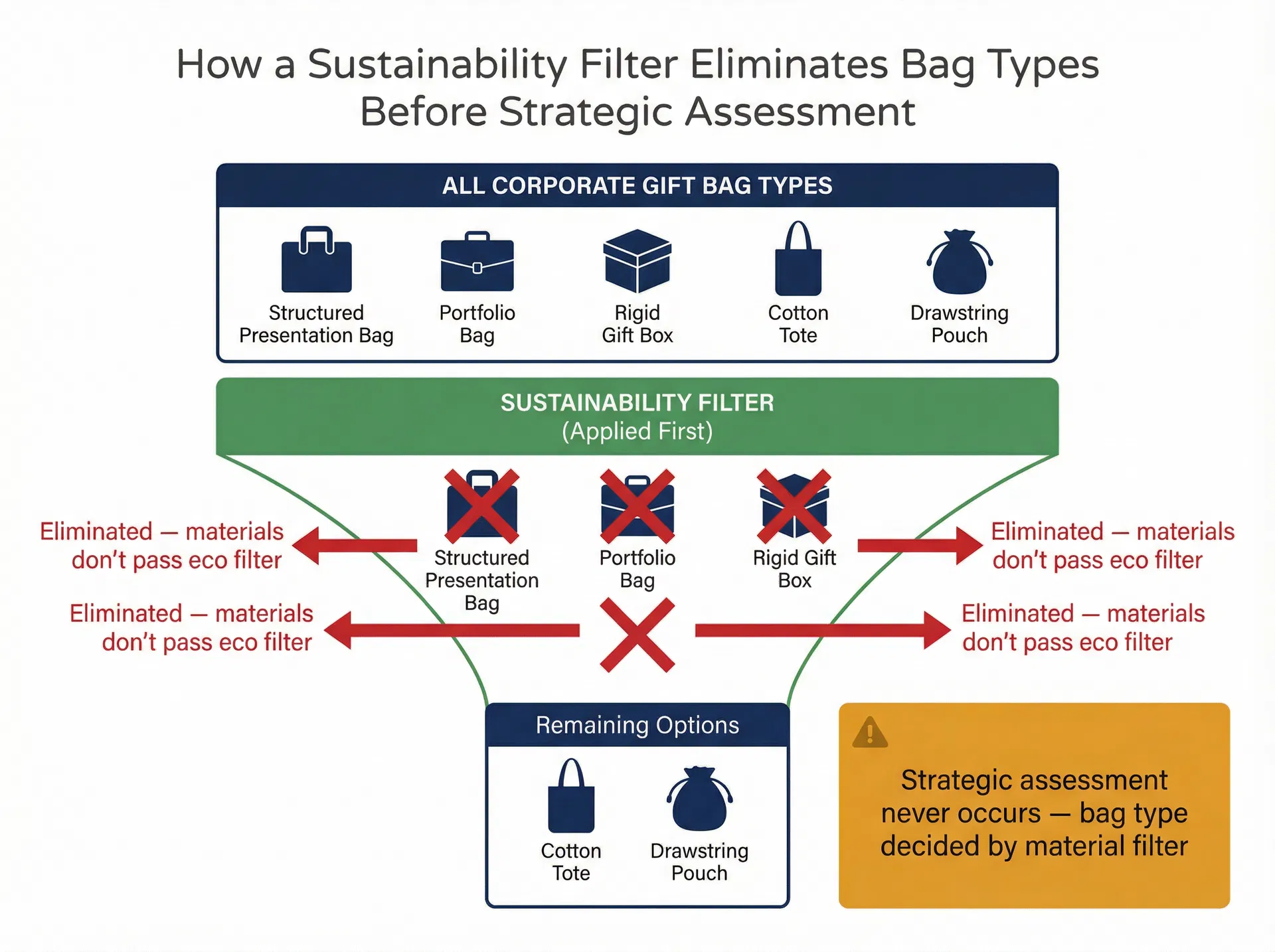
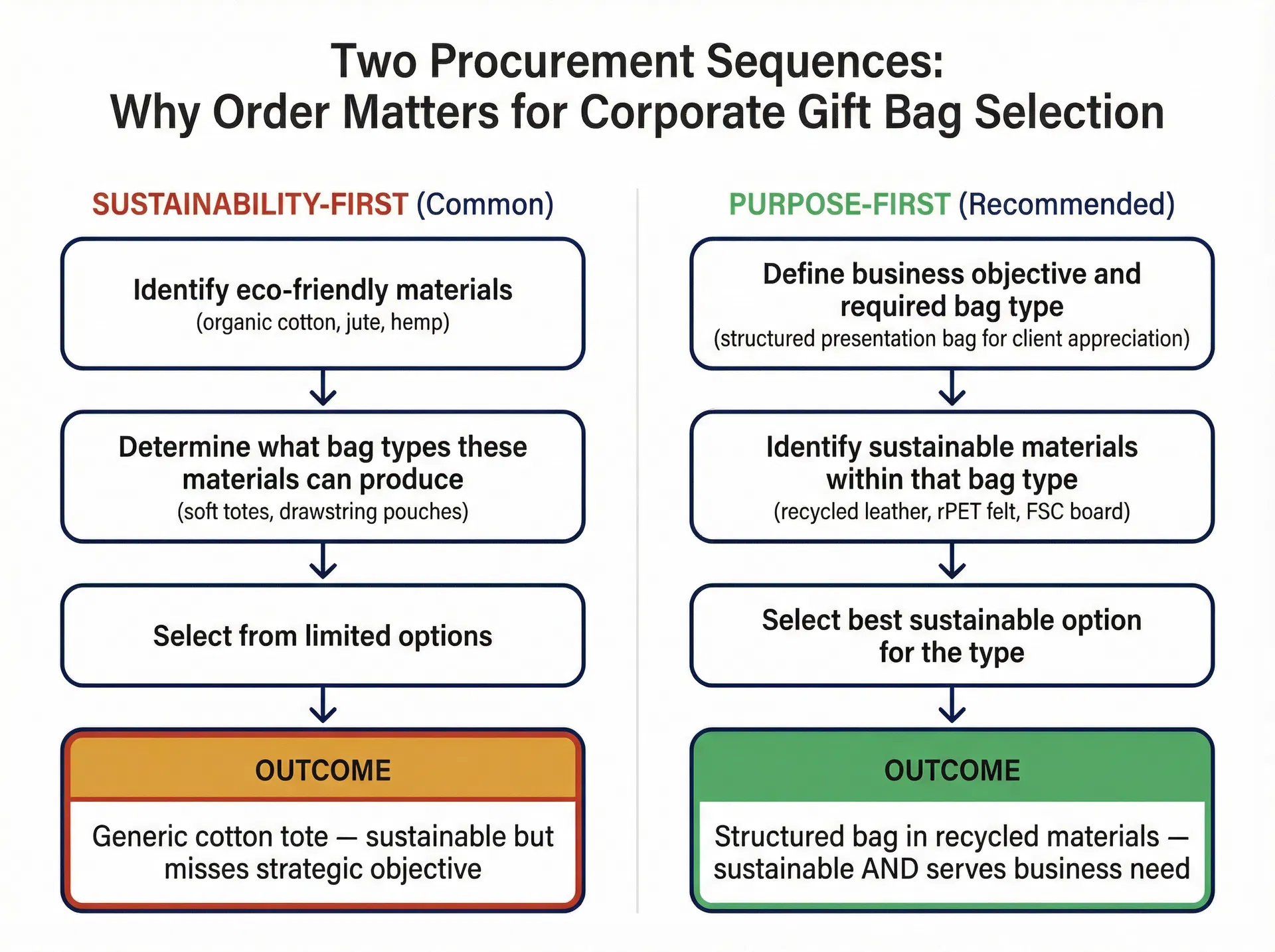
This inversion of the selection sequence is the core problem. In a well-structured procurement process, the strategic question comes first: what type of bag serves this programme's business need? The answer to that question identifies a category — structured presentation bag, portfolio-style bag, rigid gift box with handles, or indeed a cotton tote if that is what the occasion calls for. Material selection then operates within that category, identifying which sustainable options exist for that specific construction. A structured presentation bag, for instance, can be produced using recycled leather, recycled PET felt, or sustainably sourced paper board with FSC certification — all of which carry legitimate sustainability credentials but are invisible to a procurement process that begins with "which materials are eco-friendly?" rather than "which bag type achieves our objective?"
When the sequence is inverted — sustainability first, then bag type — the material becomes the independent variable and the bag type becomes whatever that material can produce. This is not a theoretical concern. It is the single most common pattern we observe in corporate gift bag programmes where the final product underperforms the brief's stated objectives. The client wanted a premium, structured bag. They received a cotton tote with their logo screen-printed on it. The tote is genuinely sustainable. It is also indistinguishable from the totes distributed by dozens of other organisations at every industry conference, charity event, and employee onboarding session in the UK. The sustainability box is ticked. The strategic objective is missed.
The problem is compounded by a secondary dynamic: the fear of greenwashing. Procurement teams operating under ESG scrutiny are understandably cautious about any sustainability claim that might be challenged. This caution creates a preference for materials that visually signal sustainability — materials that look natural, feel organic, and require no explanation. Cotton, jute, and hemp meet this criterion effortlessly. A recipient picks up a cotton tote and intuitively understands it as an eco-friendly choice. A recipient picks up a bag made from recycled ocean plastic or post-consumer PET fabric and may not recognise it as sustainable at all — it looks and feels like a synthetic material, which it technically is, despite having a significantly better lifecycle profile than virgin cotton in many analyses.
This visual signalling bias means that the sustainability requirement does not just filter by environmental credential. It filters by environmental legibility — by how obviously sustainable the material appears to a non-expert recipient. And environmental legibility correlates almost perfectly with material simplicity, which correlates almost perfectly with limited bag construction options. The more legibly sustainable the material, the fewer bag types it can produce. The fewer bag types available, the more likely the programme defaults to the universal fallback: a flat, unstructured tote.
There is a practical correction available, and it does not require abandoning sustainability commitments. The correction is sequential: define the bag type that serves the programme objective first, then identify which sustainable materials and certifications are available within that construction category. If the programme needs a structured presentation bag, the production team can source recycled leather alternatives, FSC-certified rigid board, or recycled PET felt — materials that carry verifiable sustainability credentials and support the required construction. If the programme genuinely calls for a soft tote, organic cotton or recycled cotton is an excellent choice. The point is that the bag type should be determined by the business need, and the sustainability requirement should operate as a specification within that type, not as a pre-filter that determines the type by elimination.
Understanding [how different corporate gift types serve distinct business purposes](/blog/which-types-of-corporate-gifts-are-best-for-different-business-needs) is essential before any material specification is applied, because the material question only has a meaningful answer once the bag type question has been resolved.
The lifecycle argument is also worth addressing directly, because it reinforces the case for purpose-first selection. A cotton tote that is distributed as a corporate gift and used twice before being relegated to a kitchen drawer has a poor environmental profile regardless of its organic certification. A structured presentation bag made from recycled materials that a client keeps on their desk for two years and uses regularly has a vastly better use-to-impact ratio. Sustainability in corporate gifting is not solely a material input question — it is also a retention and reuse question. A bag that serves its intended purpose well is more likely to be kept and reused, which is the single most important variable in its actual environmental performance. A bag that fails its intended purpose — a floppy tote where a structured bag was needed — is more likely to be discarded regardless of what it is made from.
The production side sees this pattern repeat with sufficient regularity that it has become a recognisable category of brief failure. The sustainability requirement is never the problem in itself. The problem is its position in the decision sequence. When it sits above the strategic question, it answers the strategic question by default — and the answer is almost always a cotton tote. When it sits below the strategic question, it becomes what it should be: a responsible constraint that ensures the strategically correct bag type is also produced in an environmentally defensible way. The difference between these two positions is the difference between a corporate gift programme that achieves its business objective sustainably and one that achieves sustainability at the expense of its business objective.