Why the Same Custom Bag Brief Produces Two Completely Different Corporate Gift Products
The phrase "premium custom gift bag" contains a structural ambiguity that most procurement briefs never resolve. Whether the bag is the corporate gift itself or the carrier for other gifts inside it determines every specification decision — material, structure, handles, interior treatment — yet the factory receives a single label for two fundamentally different products.
· By BritBag Works
When a production brief arrives describing a "premium custom gift bag" for a corporate programme, the factory faces an immediate interpretation problem that the client almost certainly has not considered. The phrase "gift bag" contains a structural ambiguity that determines every material, construction, and finishing decision that follows — but the brief rarely resolves it. The question is whether the bag is the gift, or whether the bag is carrying the gift. These are fundamentally different products with different specifications, different cost structures, and different quality benchmarks, yet they arrive at the factory floor under the same label.
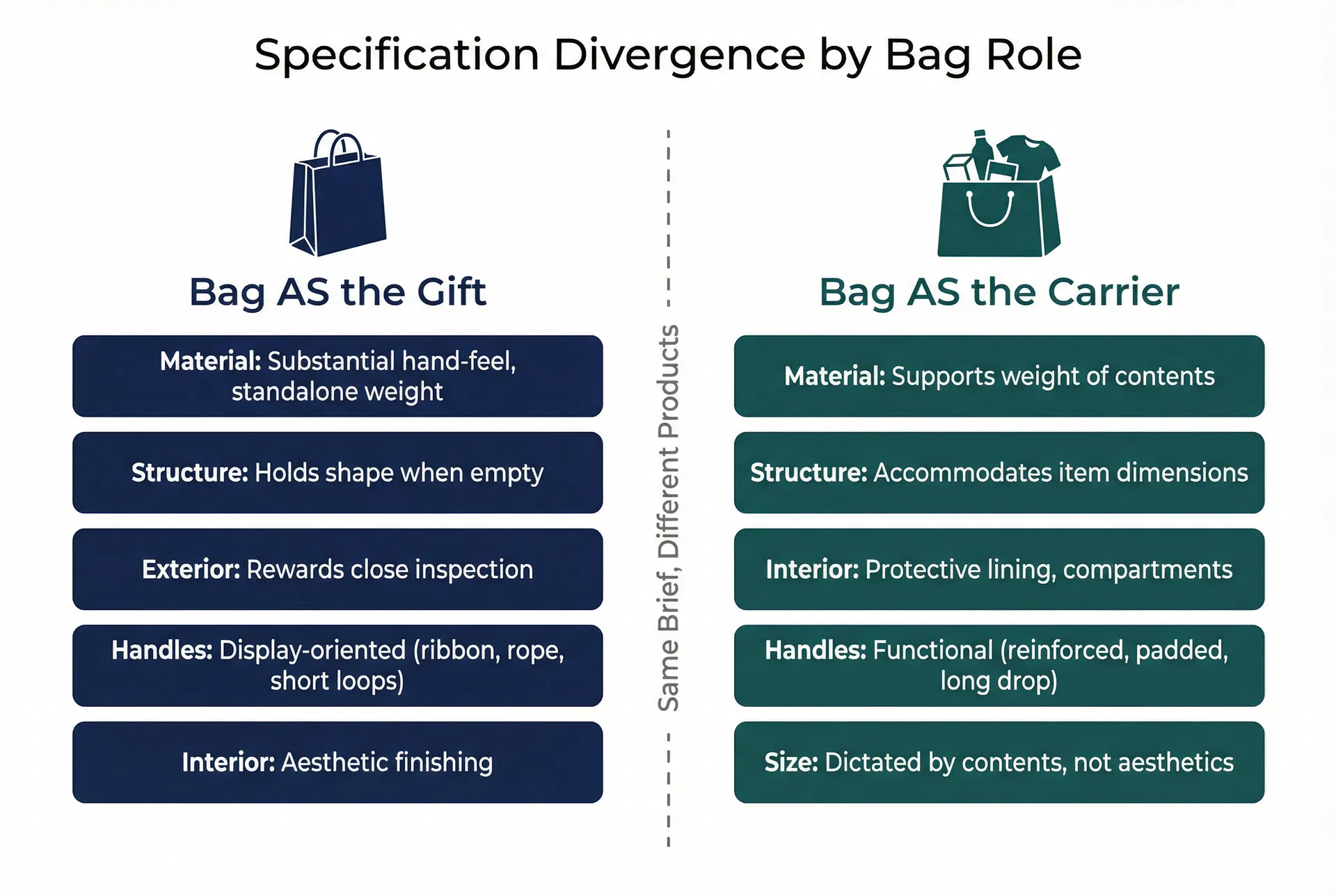
The distinction is not academic. A custom bag that functions as the corporate gift itself — the item the recipient is meant to keep, use, and associate with the giving organisation — requires a specification built around standalone perceived value. The material must feel substantial in the hand without anything inside it. The structure must hold its shape on a shelf or desk. The finishing must reward close inspection because the recipient will inspect it closely; there is nothing else in the package to divert attention. The handle design must suggest permanence rather than utility. Every element of the bag communicates directly to the recipient because the bag is the entire message.
A custom bag that functions as a carrier for other gifts inside it operates under an entirely different logic. Its primary job is to present and protect the contents. The interior treatment matters more than the exterior finish because the recipient's first sustained interaction is reaching inside. The size must accommodate the actual items being carried, which means the bag's proportions are dictated by the contents rather than by the bag's own aesthetic balance. The structure needs to support weight from within rather than hold shape when empty. The handle must be genuinely functional because the recipient will carry it, possibly for some distance, with real weight inside.
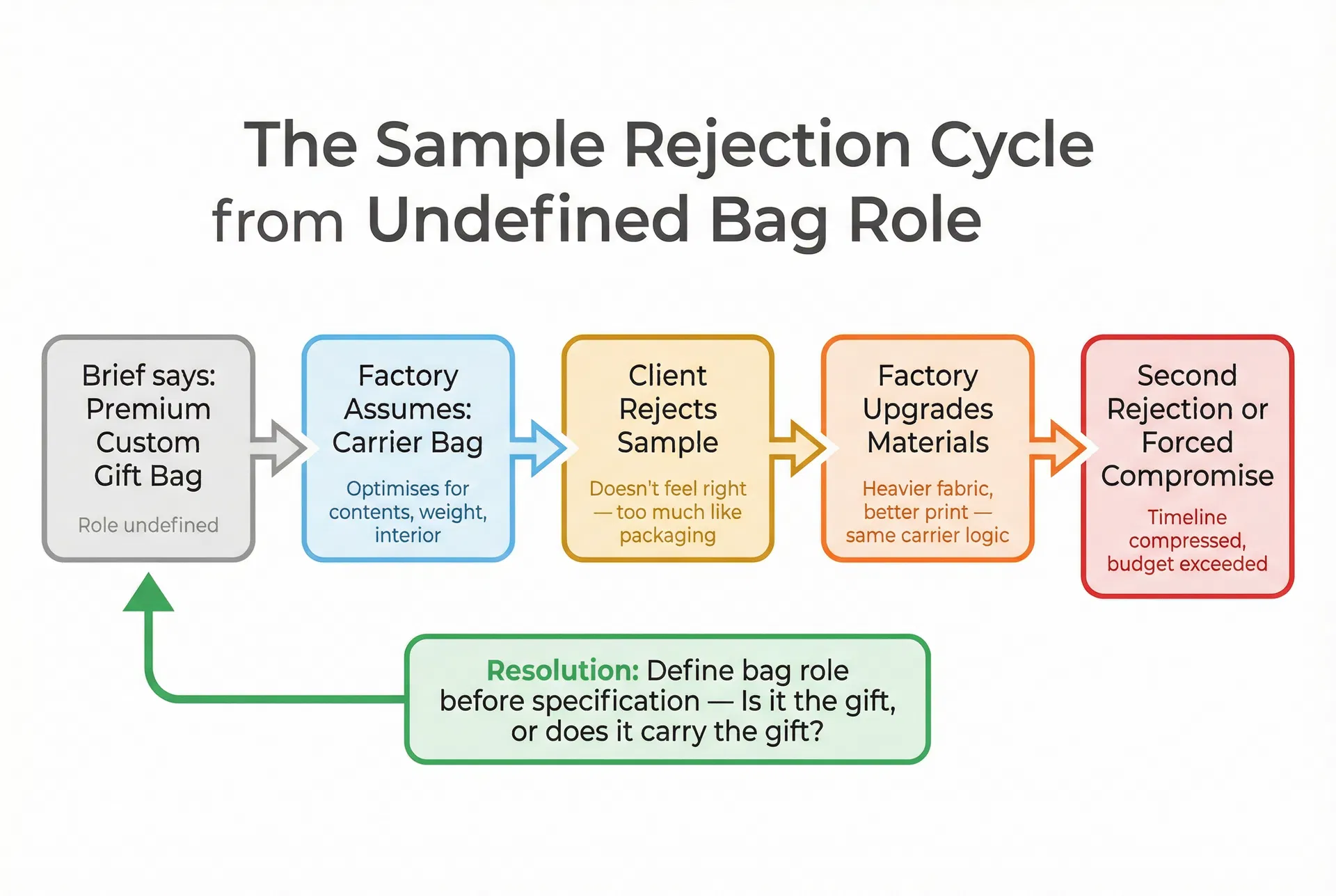
In practice, this is often where corporate gift bag type decisions start to go wrong — not at the point of supplier selection or material choice, but at the point of role definition. The procurement brief typically describes the desired outcome ("a premium branded bag for our client appreciation event") without specifying which role the bag plays in the gifting moment. The factory, working from experience, makes an assumption. If the order is for a structured cotton canvas bag with a foil-stamped logo and no mention of contents, the factory assumes it is the gift. If the order is for a bag with tissue paper and ribbon closure, the factory assumes it is a carrier. But these assumptions are not always correct, and when they are wrong, the sample that arrives at the client's office triggers a rejection that neither party fully understands.
The rejection conversation typically centres on the wrong variables. The client says the bag "doesn't feel right" or "isn't what we envisioned." The factory responds by adjusting material weight or print quality, interpreting the feedback as a quality concern. But the actual problem is a role mismatch. The client envisioned the bag as a standalone gift — something the recipient would place on a bookshelf or use as a daily carry — and the factory produced a carrier bag with premium materials. The material is fine. The construction is fine. The bag is simply the wrong type for the intended function, and no amount of material upgrading will correct a structural category error.
This mismatch creates a specific pattern of sample revision cycles that consumes time and budget without converging on a solution. The first sample is rejected for feeling "too much like packaging." The factory increases the fabric weight and adds a magnetic closure, which increases cost but does not address the underlying issue because the bag's proportions, interior treatment, and handle design still reflect carrier logic. The second sample is rejected for being "close but not quite there." The factory adjusts the logo placement and adds an interior pocket, which moves the specification further from the original cost estimate while still not resolving the role confusion. By the third sample, the project timeline is compressed, the per-unit cost has drifted upward, and the client either accepts a compromise or restarts with a different supplier — carrying the same unresolved ambiguity into the next relationship.
The reverse error is equally costly but less visible. When a bag is meant to carry a curated set of gifts — a notebook, a pen, a small box of confectionery, perhaps a branded USB drive — but is specified as a standalone gift bag, the result is a beautiful object that cannot perform its actual function. The proportions are optimised for the bag's own visual balance rather than for the items it needs to contain. The interior is unlined or finished with a decorative fabric that offers no protection for the contents. The handles are elegant but not engineered for the combined weight of multiple items. The recipient receives a visually impressive bag that they must immediately transfer the contents out of because it cannot actually carry them. The bag has succeeded as an object and failed as a tool, and the gifting moment — which depended on the recipient opening the bag and discovering the curated contents inside — is diminished by the practical awkwardness of the interaction.
The factory's perspective on this is straightforward but rarely communicated to the client. Different bag roles require different construction approaches from the very first pattern-cutting stage. A standalone gift bag is built outward from its own dimensions — the pattern is designed to create a specific silhouette, and every construction decision serves that silhouette. A carrier bag is built inward from its contents — the pattern is designed to accommodate specific items, and every construction decision serves the protection and presentation of those items. These are different engineering problems. A bag designed to look beautiful empty will not necessarily look beautiful full. A bag designed to present contents elegantly will not necessarily look impressive on its own.
The handle specification alone illustrates the divergence. A standalone gift bag benefits from handles that are visually integrated into the design — flat ribbon handles, knotted rope handles, or short leather loops that sit flush against the bag's body. These handles suggest that the bag is an object to be displayed or carried lightly. A carrier bag requires handles that distribute weight across the hand — reinforced cotton webbing, padded leather straps, or double-layered grosgrain ribbon with sufficient drop length to carry comfortably at the side. Specifying display handles on a carrier bag means the recipient struggles to carry it. Specifying functional handles on a standalone gift bag means the bag looks like it is waiting to be filled with something, which undermines its status as the gift itself.
Understanding how [the production process translates a brief into a finished bag](/blog/custom-bag-customization-process-uk-guide) makes it clear why the role definition must happen before the specification is written, not after the first sample arrives. The factory cannot reverse-engineer the client's intent from a material list and a logo file. The brief must state, explicitly, whether the bag is the gift or the carrier. If it is the gift, the specification should describe the bag as a standalone object — its intended use after the gifting moment, the environment it will occupy, the impression it should create when seen on a desk or carried in a professional setting. If it is the carrier, the specification should describe the contents — their dimensions, their combined weight, their fragility, and the sequence in which the recipient is expected to discover them.
The cost implications of this distinction are significant but not in the direction most procurement teams expect. A standalone gift bag is not necessarily more expensive than a carrier bag. In some configurations, the carrier is more costly because it requires interior reinforcement, protective lining, structured compartments, and handles engineered for sustained weight. The assumption that "the bag is just the packaging, so it should be cheaper" leads to under-specification of carrier bags that then fail to protect or present the contents they were meant to carry. Conversely, the assumption that "the bag is the gift, so it should be the most expensive element" can lead to over-specification of standalone bags that exceed the programme's budget without proportionally increasing the recipient's perceived value.
The resolution is not complex, but it requires a conversation that procurement processes typically skip. Before any material is selected, before any supplier is contacted, the programme owner needs to resolve one thing before anything else moves forward: when the recipient holds this bag, is the bag the thing they are meant to value, or is the bag the thing that presents what they are meant to value? The answer determines the type of bag, and the type determines everything else. Getting this wrong does not produce a bad bag. It produces the wrong bag — a well-made product that fails its purpose because its purpose was never defined.