Why the Per-Unit Budget Approach to Corporate Gift Bags Systematically Selects the Wrong Type
When procurement teams set a per-unit budget ceiling before defining the strategic purpose of a corporate gift bag, the resulting constraint eliminates entire categories of bags from consideration. The budget does not merely limit quality — it determines which types are available, and those types may be fundamentally wrong for the intended business context.
· By BritBag Works
There is a particular sequence error in corporate gift bag procurement that repeats across organisations of every size, and it is so embedded in standard purchasing practice that it rarely gets questioned. The sequence is this: finance allocates a total gifting budget, procurement divides that figure by the number of recipients, and the resulting per-unit ceiling becomes the primary constraint for selecting the bag. Everything that follows — supplier shortlisting, material options, construction methods, finishing techniques — is filtered through that number. The problem is not the budget itself. The problem is that the per-unit figure determines which types of bags are even available before anyone has asked what the bag is supposed to accomplish.
At eight pounds per unit, the selection is already narrowed to a specific band of products. Non-woven polypropylene bags, lightweight cotton totes under 140gsm, basic polyester drawstring bags. These are functional products with legitimate uses in event giveaway contexts, but they share a common characteristic: they communicate "promotional item" before the recipient reads the logo. The material weight, the handle construction, the print quality achievable at that price point — all of these signal a category. The recipient does not need to know the unit cost to understand what category the bag occupies. They feel it in the fabric weight, see it in the stitching, and register it in the way the bag holds its shape or fails to.
This is where the type-selection error begins. The budget ceiling has not merely limited quality within a chosen bag type. It has eliminated entire categories of bags from consideration. Structured canvas totes, reinforced jute bags with laminated interiors, premium cotton bags at 280gsm or above, leather-trimmed portfolio bags — none of these exist at eight pounds per unit in any meaningful production volume. The procurement team is not choosing between good and better versions of the right type of bag. They are choosing between variations of a type that may be fundamentally wrong for the intended purpose.
The distinction matters because different types of corporate gift bags serve different strategic functions, and those functions are not interchangeable. A lightweight promotional tote distributed at a trade show serves a visibility function: it carries materials, displays a logo, and circulates through the event space. Its value is measured in impressions per hour. A gift bag presented to a client at a relationship-building dinner serves a completely different function: it signals investment, taste, and the weight the company places on the relationship. These are not points on a spectrum. They are different categories of communication, and they require different types of bags.
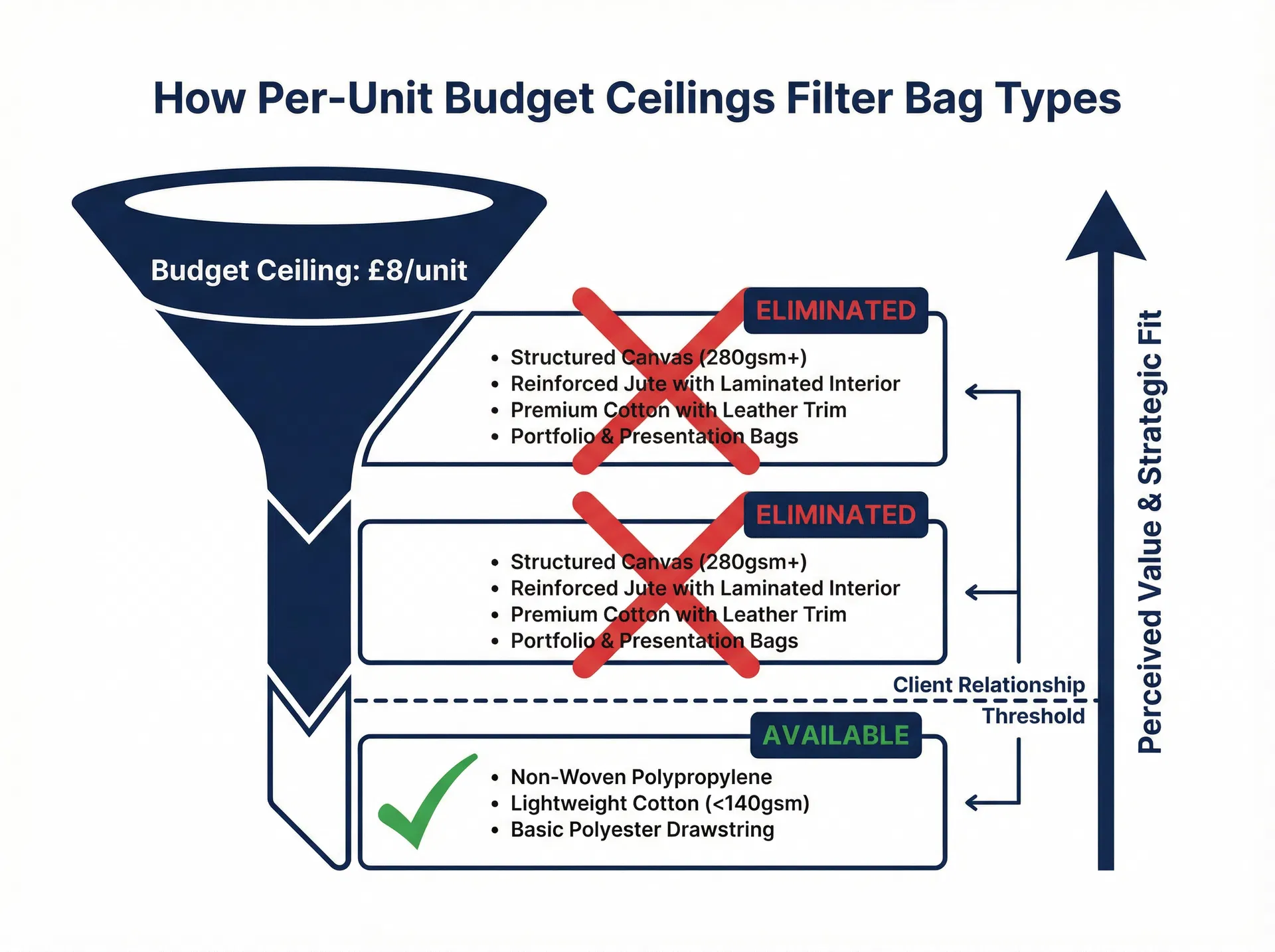
When the per-unit budget is set before the strategic purpose is defined, the procurement process cannot distinguish between these functions. It treats all gift bags as a single category — "branded bags" — and optimises for the lowest cost within that undifferentiated category. The result is a bag that may be perfectly adequate for trade show distribution but is visibly wrong for client gifting, or a bag that is over-specified for an internal team event but under-specified for an executive welcome package. The budget has selected the type, and the type has determined the message, before anyone in the organisation has explicitly decided what message they wanted to send.
The consequences of this sequence error are not always immediately visible, which is part of why it persists. A recipient who receives a lightweight non-woven bag at a client dinner does not typically complain. They accept it politely, and the bag disappears — into a bin, a drawer, or a pile of similar items that accumulate from vendors who all made the same procurement decision. The absence of complaint is interpreted as success. The gifting programme is marked as delivered on time and within budget. But the strategic objective — reinforcing the relationship, signalling quality, creating a lasting brand association — has not been achieved. The bag was the wrong type for the context, and the budget ceiling made that outcome inevitable before the first supplier was contacted.
What makes this particularly difficult to correct is that the per-unit budget approach feels like responsible financial management. It provides a clear, defensible constraint. If questioned, the procurement team can point to the approved budget and demonstrate compliance. The problem is that compliance with a budget target is not the same as effectiveness in achieving the gifting objective. A programme that spends exactly the approved amount on bags that fail to create any lasting impression has a real cost that does not appear on the procurement dashboard: the cost of a missed opportunity, multiplied by every recipient who received a bag that told them, through its material and construction, that the relationship was worth eight pounds.
The correction is not to abandon budget discipline. It is to reverse the sequence. The first question should be: what is this bag supposed to accomplish, and for whom? If the answer is "reinforce a strategic client relationship at a formal event," the type of bag required becomes specific — structured, premium material, refined finishing, presentation-quality packaging. The cost of that type can then be calculated. If the resulting per-unit price exceeds the original budget allocation, the decision becomes explicit and transparent: reduce the number of recipients, adjust the total allocation, or accept that the gift will not achieve its stated purpose. Any of these is a better outcome than the current default, which is to select a bag type that cannot achieve the purpose and then distribute it to everyone on the list.
The practical implication for procurement teams is that the type assessment needs to happen before the budget division. This means involving the stakeholders who understand the strategic context — marketing, client relations, HR — before the per-unit ceiling is established. It means asking whether the recipient list should be segmented by relationship tier, with different bag types allocated to different tiers rather than one type applied uniformly. It means recognising that a programme serving three hundred recipients at eight pounds each may be less effective than one serving one hundred and fifty recipients at sixteen pounds each, even though the total spend is identical.
Understanding how [different bag types align with specific business contexts](/blog/custom-bag-customization-process-uk-guide) reveals why the type decision is the most consequential choice in the entire procurement process — more consequential than supplier selection, more consequential than colour matching, more consequential than delivery timing. A well-chosen type compensates for minor imperfections in execution. A poorly chosen type cannot be rescued by perfect execution.
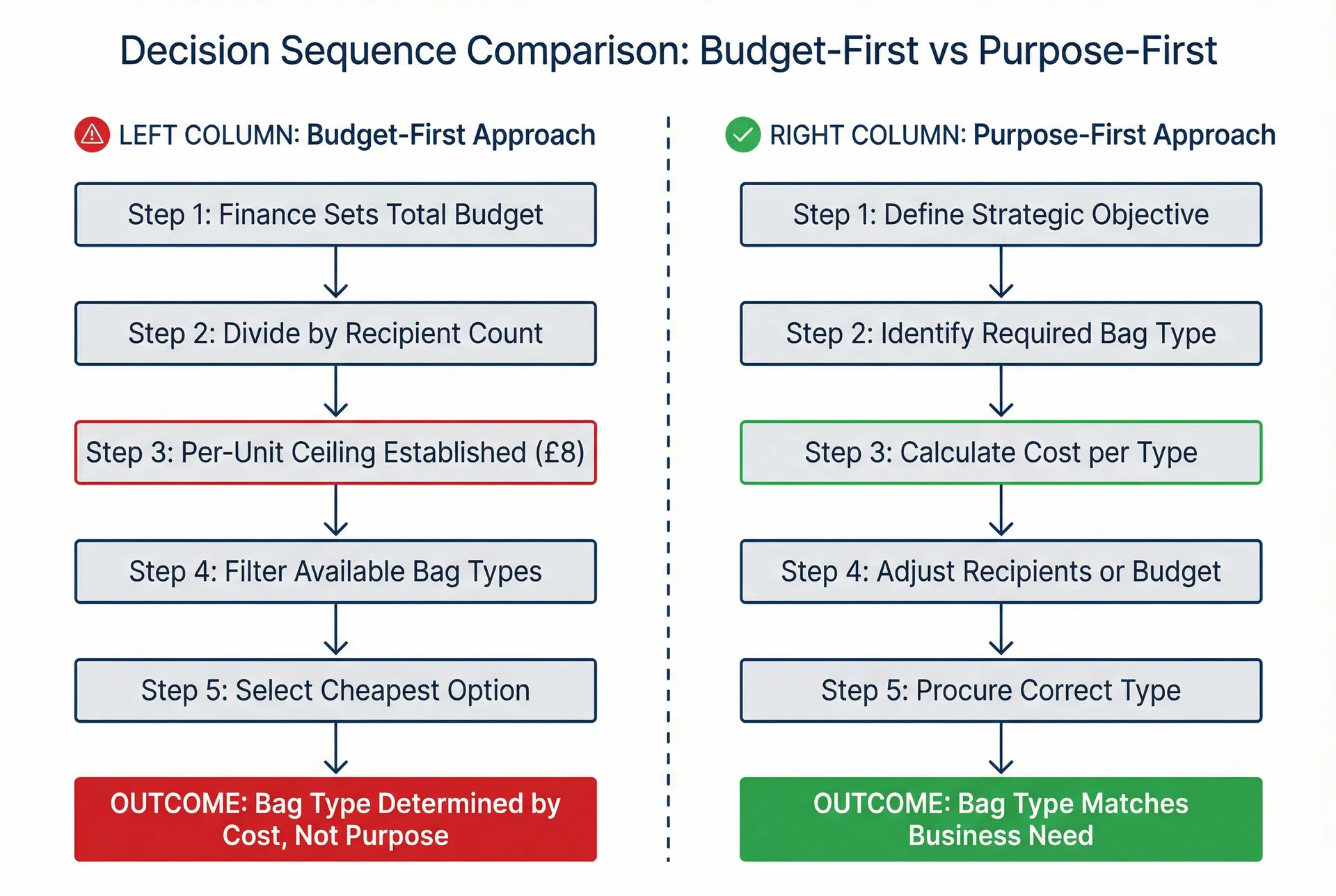
The pattern is consistent across industries and organisation sizes. Companies that set the per-unit budget first and then search for the best bag within that constraint end up with bags that are optimised for cost and wrong for context. Companies that define the context first and then determine the budget required for the appropriate bag type end up spending similar total amounts but achieving measurably different outcomes. The difference is not in the money. It is in the sequence. And the sequence, once established as organisational habit, tends to repeat unchallenged because it produces results that look correct on a spreadsheet while failing silently in the hands of every recipient who can feel the difference between a bag that was chosen for them and a bag that was chosen for the budget.