How Multi-Stakeholder Approval Processes Systematically Produce the Wrong Corporate Gift Bag Type
When marketing, HR, finance, and procurement each evaluate a corporate gift bag programme against their own success criteria, the veto-driven approval process eliminates every strategically distinctive option. The surviving bag type is not selected because it serves the programme objective — it survives because no department actively rejected it.
· By BritBag Works
The programme brief was clear enough on paper. A UK financial services firm needed eight hundred custom branded bags for a client appreciation initiative tied to their annual review season. The marketing director wanted a structured, premium-feel bag with prominent foil-stamped branding — something clients would photograph and share. The HR lead, who had been pulled into the project because the programme also included internal recipients, wanted something practical and understated that employees would actually reuse. Finance had approved a per-unit ceiling that made the marketing director's preferred specification difficult but not impossible. And the procurement manager, who was coordinating the supplier relationship, needed a bag type that could be produced within the confirmed six-week window without requiring a new tooling setup. Four departments, four sets of criteria, one bag. The result was a mid-weight cotton tote with a screen-printed logo, flat handles, and no internal structure. It satisfied every stakeholder's minimum threshold and none of their actual objectives.
This outcome is not unusual. It is, in fact, the default outcome when corporate gift bag programmes are subject to multi-stakeholder approval processes. The mechanism is predictable and the consequences are consistent, yet the pattern rarely gets examined because the programme technically succeeds — it delivers on time, within budget, with branding present. The problem is that technical success and strategic effectiveness are not the same thing, and the gap between them is almost always created by the approval process itself.
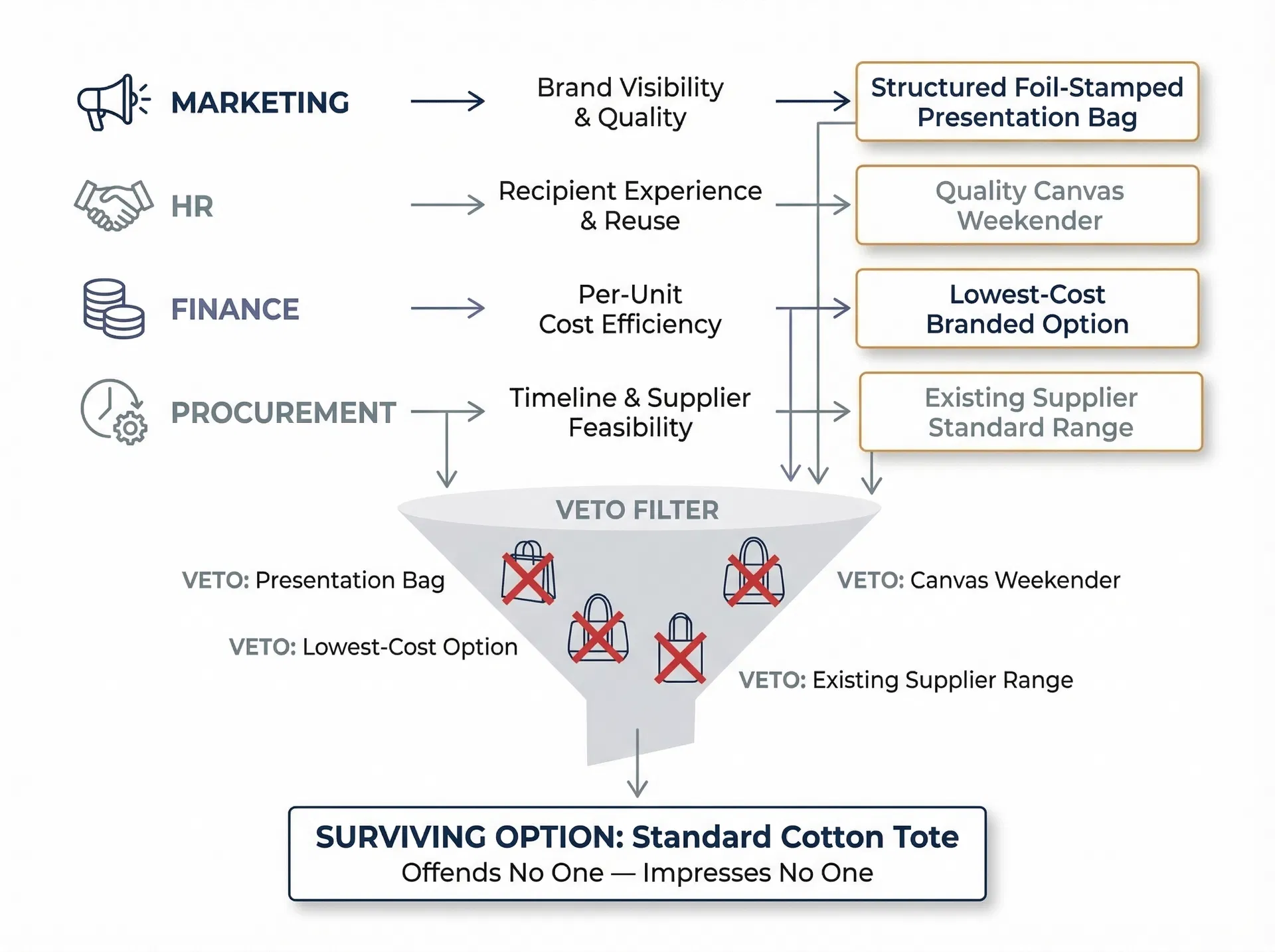
The way this typically unfolds is worth understanding in detail, because the failure is structural rather than individual. Each stakeholder evaluates the proposed bag type against their own department's success metric, which is entirely rational from their position. Marketing assesses brand visibility and perceived quality — will this bag make the company look good? HR assesses recipient experience and inclusivity — will people actually want this, and will it feel like a genuine gesture rather than branded merchandise? Finance assesses cost efficiency — does this fit within the approved budget, and is the per-unit cost justifiable relative to the programme's stated ROI? Procurement assesses feasibility — can this be produced reliably within the timeline, and does the supplier have the capability to deliver this specification at this volume?
Each of these assessments is legitimate. The problem is that they operate on different axes, and the bag type that scores adequately on all four axes is rarely the bag type that scores well on any single one. Marketing's preferred bag — a rigid, foil-stamped presentation bag with ribbon handles — fails finance's cost threshold and procurement's timeline constraint. HR's preferred bag — a high-quality, unbranded or subtly branded canvas weekender — fails marketing's visibility requirement and finance's per-unit ceiling. Finance's preferred bag — the lowest-cost option that still carries the logo — fails marketing's quality standard and HR's recipient experience criterion. Procurement's preferred bag — whatever the existing supplier can produce without retooling — may fail all three other departments' requirements depending on what that supplier's standard range includes.
The resolution mechanism in most organisations is not a strategic decision. It is a process of elimination. Each stakeholder vetoes the options that violate their minimum threshold, and the bag type that survives the veto process is the one that remains. This surviving option is not selected because it is the best choice for the programme's objective. It is selected because it is the only choice that no one actively rejected. In procurement language, this is sometimes called a "consensus selection," but consensus implies agreement. What actually occurs is the absence of objection, which is a fundamentally different thing.
The practical consequence of this process is that the bag type defaults to the category with the widest tolerance band — the category that is inoffensive enough to pass through every filter without triggering a veto. In the UK market, this almost invariably means a standard cotton tote bag. Cotton totes are inexpensive enough for finance, brandable enough for marketing, practical enough for HR, and simple enough for procurement to source within any reasonable timeline. They are also, by virtue of being the default compromise, the single most forgettable category of corporate gift bag. Recipients have received dozens of cotton totes from dozens of organisations. The bag communicates nothing about the specific relationship between the sender and the recipient. It communicates only that a process was followed.
The deeper issue is that the approval process treats bag type selection as a risk-management exercise rather than a strategic one. Each stakeholder's evaluation criteria is oriented toward avoiding a negative outcome within their domain — marketing wants to avoid looking cheap, HR wants to avoid employee complaints, finance wants to avoid budget overruns, procurement wants to avoid delivery failures. When every participant is optimising to avoid their worst-case scenario, the collective output gravitates toward the centre of the risk distribution. The centre of the risk distribution is, by definition, the most average option available. And average is precisely what a corporate gift programme cannot afford to be if it intends to create a meaningful impression.
In practice, this is often where decisions about [matching the right bag type to a specific business need](/blog/which-types-corporate-gifts-best-different-business-needs) begin to lose their strategic grounding. The initial brief may have correctly identified the programme's purpose — client retention, employee recognition, event branding — but the approval process introduces evaluation criteria that have nothing to do with that purpose. Finance's per-unit ceiling is a budget constraint, not a strategic input. Procurement's timeline feasibility is an operational constraint, not a strategic input. These constraints are real and must be respected, but they should bound the selection rather than drive it. When constraints become the primary selection criteria, the bag type is chosen for its compatibility with internal processes rather than its effectiveness with external recipients.
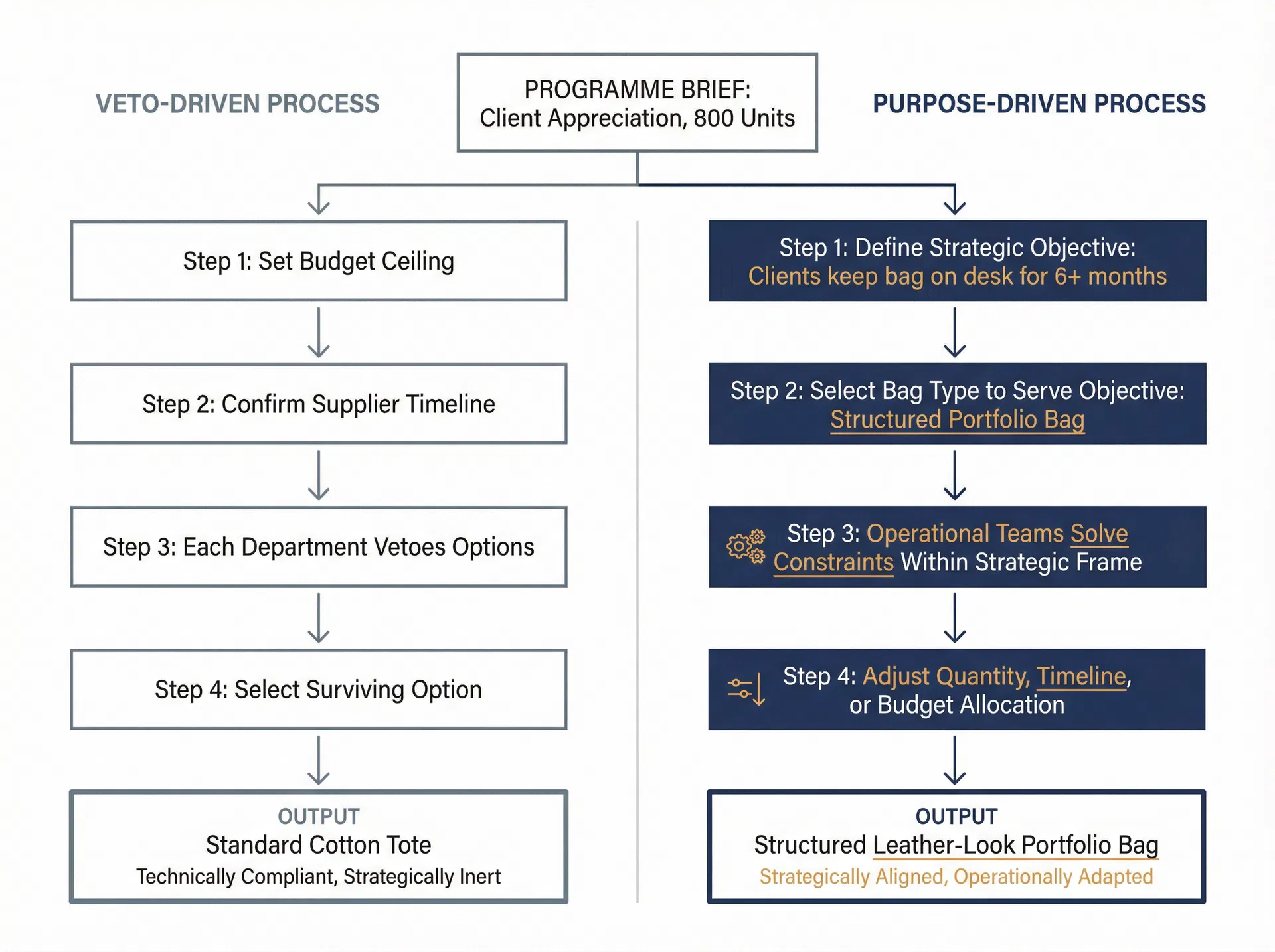
The correction requires a change in the sequence of the approval process, not the elimination of stakeholders. The programme's strategic objective must be defined and agreed upon before departmental evaluation begins. If the objective is client retention through a premium, memorable gesture, then the bag type must be selected to serve that objective first. Finance, procurement, and other operational stakeholders then work within that strategic frame to identify how the selected bag type can be delivered within their constraints — adjusting quantity, phasing delivery, negotiating supplier terms, or reallocating budget from other programme elements. This is the inverse of the typical process, where operational constraints are established first and the bag type is whatever survives them.
The difference in output between these two approaches is not marginal. A purpose-driven process for the same client appreciation programme might produce a structured leather-look portfolio bag with debossed branding and a magnetic closure — a bag type that clients associate with quality and keep on their desk rather than in a drawer. The per-unit cost is higher, which means finance may need to approve a smaller quantity or a reallocation from another budget line. The production timeline may be longer, which means procurement needs to initiate the order earlier. These are solvable operational problems. The unsolvable problem is a programme that delivers eight hundred forgettable cotton totes to clients the firm is trying to retain, because the approval process optimised for internal comfort rather than external impact.
The most telling indicator of whether a bag type was selected strategically or by compromise is what happens when the programme is evaluated afterward. If the post-programme review focuses on whether the bags arrived on time and within budget, the selection was driven by operational criteria. If the review focuses on whether recipients responded to the bags in ways that advanced the programme's stated objective — kept them, used them visibly, mentioned them in follow-up conversations — the selection was driven by strategic criteria. Most organisations conduct the first type of review, which confirms the compromise selection as successful and perpetuates it into the next cycle. The bag type becomes institutionalised not because it works, but because it does not visibly fail.
Breaking this cycle requires someone in the approval process to articulate what the programme is actually trying to achieve in terms that are specific enough to evaluate against. "Client appreciation" is not specific enough. "Delivering a bag that clients keep on their desk and associate with our brand for at least six months" is specific enough to disqualify a cotton tote and point toward a structured, premium bag type. "Employee recognition that feels personal rather than corporate" is specific enough to disqualify a heavily branded tote and point toward a high-quality, subtly branded bag with genuine utility. The specificity of the objective determines whether the approval process produces a strategic selection or a default compromise. Without that specificity, the process will always converge on the safest, most average, least memorable option — because that is what multi-stakeholder veto processes are designed to produce.