Why the Distribution Channel — Not the Brand Brief — Determines Which Corporate Gift Bag Type Actually Works
The bag type that wins approval in a boardroom sample review may not survive its actual distribution channel. Postal compression destroys structured bags, conference carry exhausts short-handled designs, and desk drops demand self-standing forms. The physical journey from warehouse to recipient imposes constraints that override aesthetic preferences and strategic intent.
· By BritBag Works
The sample that secured board approval was a structured cotton canvas bag with a debossed logo, magnetic closure, and short rope handles. It looked exceptional on the conference table where the procurement team reviewed it — upright, symmetrical, the logo catching light at exactly the right angle. Everyone agreed it communicated the premium positioning the programme required. The order was confirmed for twelve hundred units. Six weeks later, the bags were packed into outer cartons and dispatched via courier to four hundred recipients across the UK. Roughly a third arrived with the magnetic closure dented inward, the structured side panels creased from compression during transit, and the rope handles twisted from being pressed flat inside shipping boxes. The bag that won approval in a boardroom had never been tested against the physical reality of its distribution channel.
This is a pattern that repeats with uncomfortable regularity across corporate gift bag programmes, and it stems from a specific blind spot in how bag type decisions are made. The selection process evaluates the bag as a static object — how it looks, how it feels in the hand, how the branding reads at arm's length. But the bag does not exist as a static object. It exists within a distribution channel that imposes physical forces the selection process never considered. The channel determines which bag types can survive the journey from warehouse to recipient, and that determination is absolute. A bag type that cannot withstand its distribution channel does not arrive as a slightly compromised version of itself. It arrives as a different product entirely — one that communicates carelessness rather than premium intent.
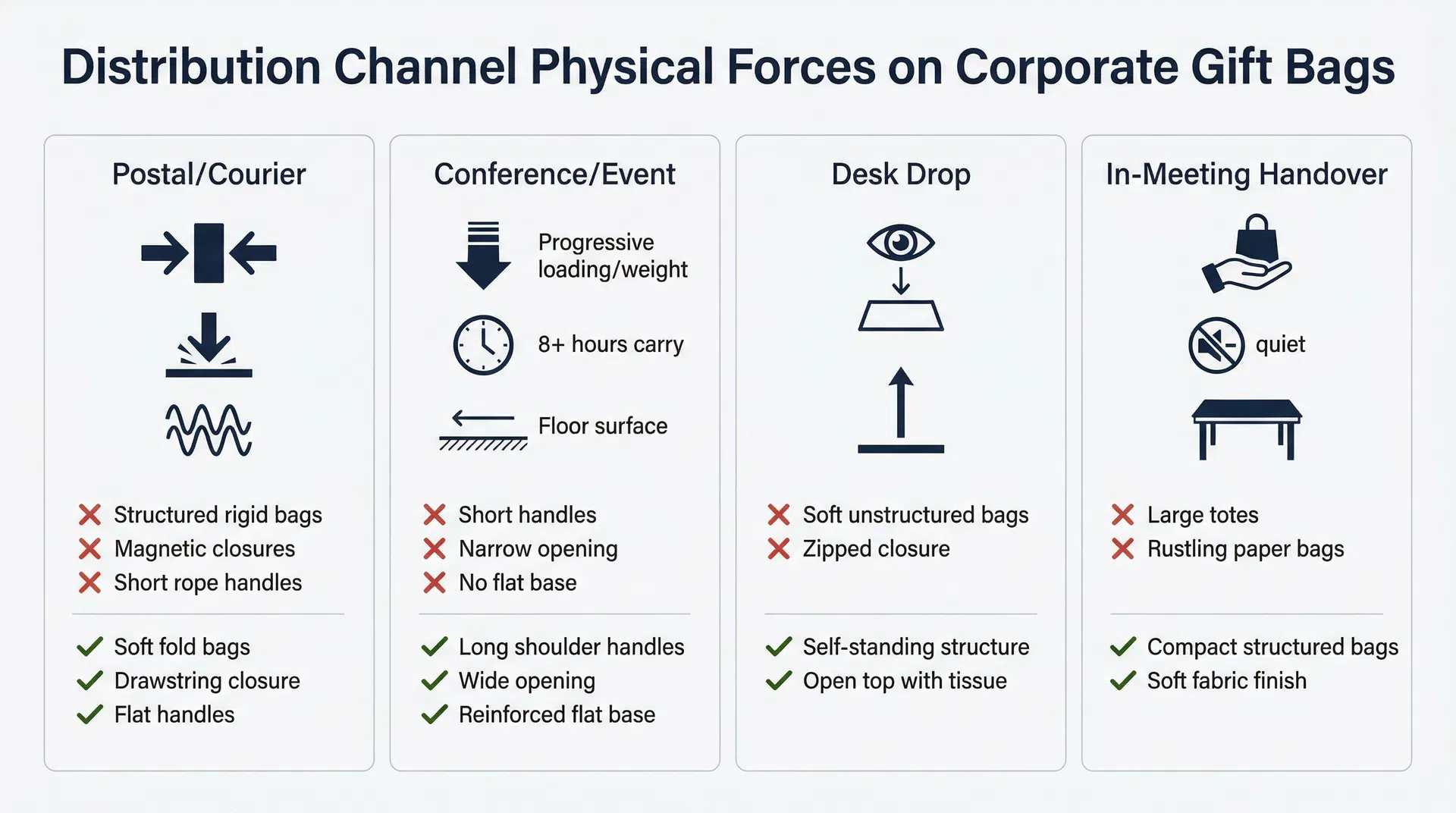
The postal and courier channel is the most destructive, and it is also the channel most frequently underestimated. When a bag is shipped inside an outer carton, it is subject to compression from stacking, lateral pressure from adjacent packages, impact from drops during sorting, and vibration during transit. Structured bags with rigid side panels are particularly vulnerable because the structure that makes them look impressive on a table becomes a liability in transit — the panels resist compression up to a point and then crease permanently, creating visible damage that cannot be reversed. Magnetic closures, which feel satisfyingly precise in a showroom, become dent points where external pressure concentrates. Short handles, which look elegant when the bag is displayed upright, tangle and twist when the bag is laid flat inside a shipping box. The bag was designed to stand. The distribution channel forces it to lie down.
The conference and event channel imposes a different set of forces. A bag handed to an attendee at registration will be carried for hours, set down on floors, tucked under chairs, filled with collected materials throughout the day, and eventually carried to a car or public transport. The bag must accommodate progressive loading — it starts light and gets heavier as the event continues. It must have handles long enough to carry comfortably at the side, a base wide enough to stand unsupported on the floor, and an opening wide enough to insert documents and brochures without folding them. A premium structured gift bag with short handles and a narrow opening may look superior to a simple cotton tote at the selection stage, but at a conference it becomes an object the recipient struggles with all day. The premium impression created during the first thirty seconds of receiving the bag is steadily eroded over the following eight hours of practical frustration.
The desk-drop channel — where bags are placed on employees' desks before they arrive — operates under constraints that are almost entirely visual rather than structural. The bag must stand upright without support, because no one is holding it when the recipient first sees it. The first viewing angle is from above, as the recipient approaches their desk, which means the top of the bag and its opening are the primary visual surfaces rather than the front panel where the logo typically sits. A bag with a wide, open top and visible tissue paper creates an immediate sense of anticipation from above. A bag with a zipped or magnetic closure looks like a package rather than a gift from the same angle. The desk-drop channel also requires the bag to remain stable on a desk surface, which eliminates soft, unstructured bags that slump sideways when placed without being held.
The in-meeting hand-delivery channel is the most intimate and the most constrained. The bag is passed across a table or handed directly to the recipient in a professional setting. It must be easy to accept with one hand, because the recipient may be holding a coffee cup, a phone, or extending a hand for a handshake. It must not produce excessive noise — paper bags with stiff handles rustle and crinkle, which creates an awkward moment in a quiet meeting room. It must be proportioned to sit on a meeting table without dominating the space or tipping over. And it must look complete from every angle, because in a meeting setting the bag will be viewed from multiple positions around the table. Large conference totes are entirely wrong for this channel. So are oversized structured bags that require two hands to manage.
The fundamental problem is that the sample approval process takes place in a physical environment that resembles none of these distribution channels. The sample sits on a clean, flat surface in a well-lit room. No one stacks anything on top of it. No one carries it for eight hours. No one views it from above while walking toward a desk. No one tries to accept it with one hand while maintaining a conversation. The sample environment is optimised for aesthetic evaluation, and the bag type that wins aesthetic evaluation is not necessarily the bag type that survives its actual distribution channel. In practice, this is often where corporate gift bag type decisions begin to diverge from the programme's actual requirements — the selection is made in one physical context and deployed in another.
Understanding [which bag types align with different business contexts](/blog/which-types-corporate-gifts-best-different-business-needs) is necessary but not sufficient. The business context determines the strategic intent — client retention, employee recognition, event branding — but the distribution channel determines the physical constraints. A client retention programme that distributes bags via courier requires a fundamentally different bag type than a client retention programme that hand-delivers bags during meetings, even though the strategic intent is identical. The bag type must satisfy both the strategic requirement and the channel requirement simultaneously, and when these requirements conflict, the channel requirement must take priority. A strategically perfect bag that arrives damaged communicates nothing except that the sender did not think through the delivery.
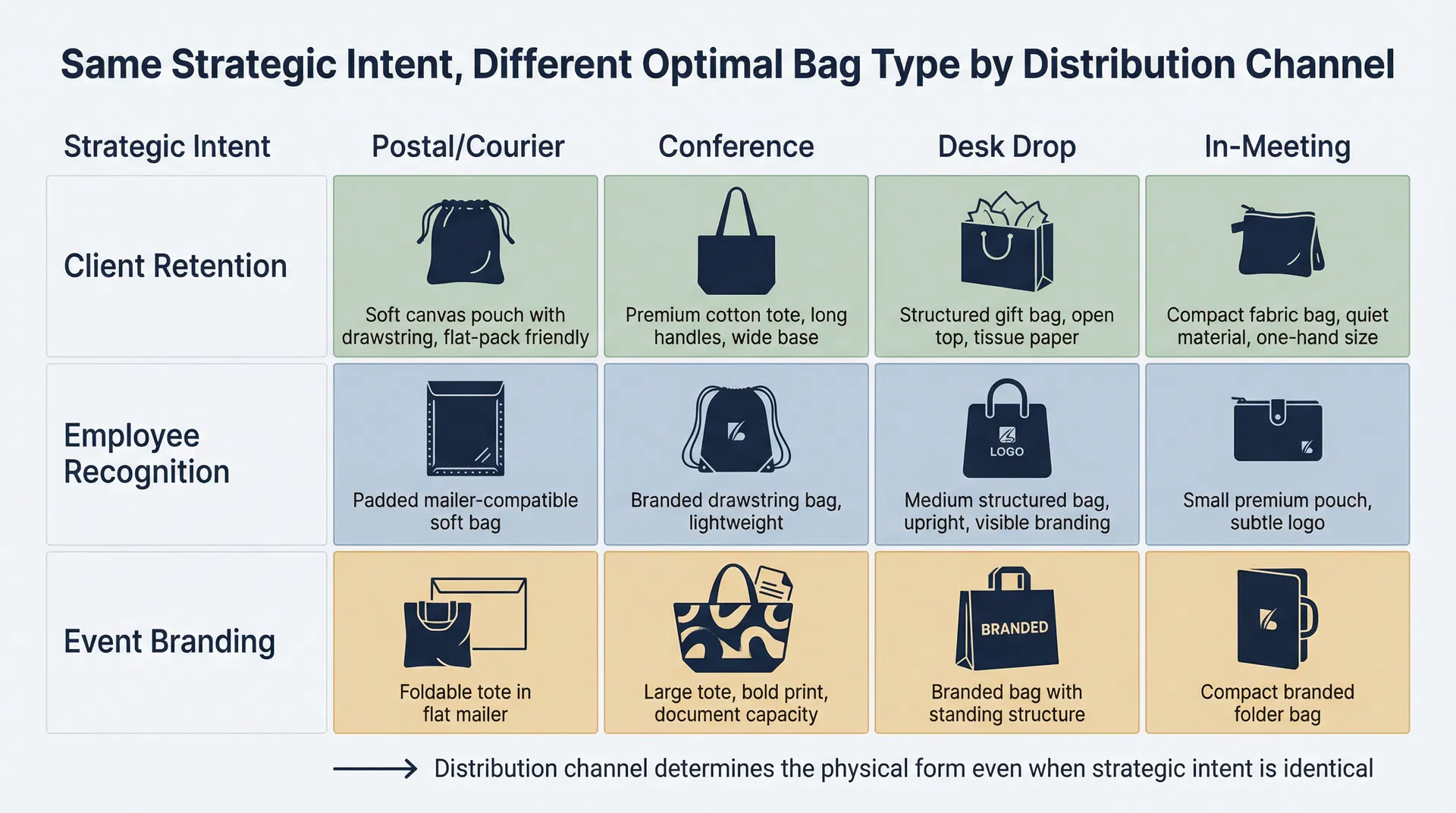
The practical consequence of ignoring the distribution channel is not merely aesthetic damage. It is a category error in bag type selection that no amount of material quality or production precision can compensate for. Upgrading the fabric weight on a structured bag does not prevent it from creasing in a courier box. Adding reinforced stitching to short handles does not make them comfortable for all-day conference carry. Improving the print quality on a large tote does not make it appropriate for a quiet meeting room. These are not quality problems. They are type problems — the wrong category of bag deployed through the wrong channel.
The correction is straightforward but requires a change in the sequence of decisions. Before the bag type is selected, before the material is chosen, before the sample is requested, the distribution channel must be defined with specificity. Not "we'll ship them" but "they will be packed individually in corrugated mailers and delivered via Royal Mail 48-hour service." Not "they're for an event" but "they will be handed out at a registration desk at 8:30am and carried by attendees through a full-day conference with lunch, three breakout sessions, and a networking reception." The level of detail matters because the physical forces are specific. A bag that survives Royal Mail 48-hour may not survive a pallet-loaded freight shipment. A bag that works for a half-day morning event may fail at a full-day conference where attendees collect materials at every session.
The sample approval process itself needs to simulate the distribution channel rather than the boardroom. If the bag will be shipped, the sample should be packed in the actual outer packaging, shipped via the actual carrier, and evaluated after it arrives rather than before it leaves. If the bag will be carried at a conference, the sample should be filled with representative weight and carried for an hour. If the bag will be desk-dropped, the sample should be placed on a desk and viewed from a standing approach angle. These are not elaborate testing protocols. They are basic physical validations that take minutes to perform and prevent weeks of post-delivery damage assessment, complaint management, and programme reputation repair.