When Procurement Timeline Pressure Quietly Eliminates the Corporate Gift Bag Types That Would Have Worked Best
A delay of just two or three weeks in the procurement process can eliminate entire categories of corporate gift bag construction from the available options — not because of budget, but because structured bag types require incompressible production stages that cannot be accelerated.
· By BritBag Works
There is a pattern in corporate gift bag procurement that repeats with remarkable consistency across UK organisations, and it operates almost entirely below the level of conscious decision-making. A programme is conceived months in advance — a client appreciation initiative, a conference welcome package, an employee recognition scheme — and the strategic intent is clear. The bag should communicate quality. It should reflect the brand's positioning. It should be something the recipient keeps rather than discards. The team discusses materials, finishes, and branding approaches. They have a vision for a structured presentation bag, perhaps a rigid-walled portfolio with embossed detailing, or a custom magnetic-closure gift box with ribbon handles. Then the procurement process begins late, and by the time the order reaches the production floor, the only bag types that can be delivered within the remaining window are the ones that were never part of the original vision.
This is not a story about poor planning, though planning is certainly a factor. It is a story about how the production timeline for different bag types varies so dramatically that a delay of even two or three weeks can eliminate entire categories of construction from the available options. Most procurement teams understand that late orders mean tighter schedules. What they do not fully appreciate is that timeline pressure does not compress all bag types equally. It does not simply make every option slightly more rushed. It removes certain types entirely, because the physical processes required to produce them cannot be meaningfully accelerated regardless of budget, urgency, or supplier willingness.
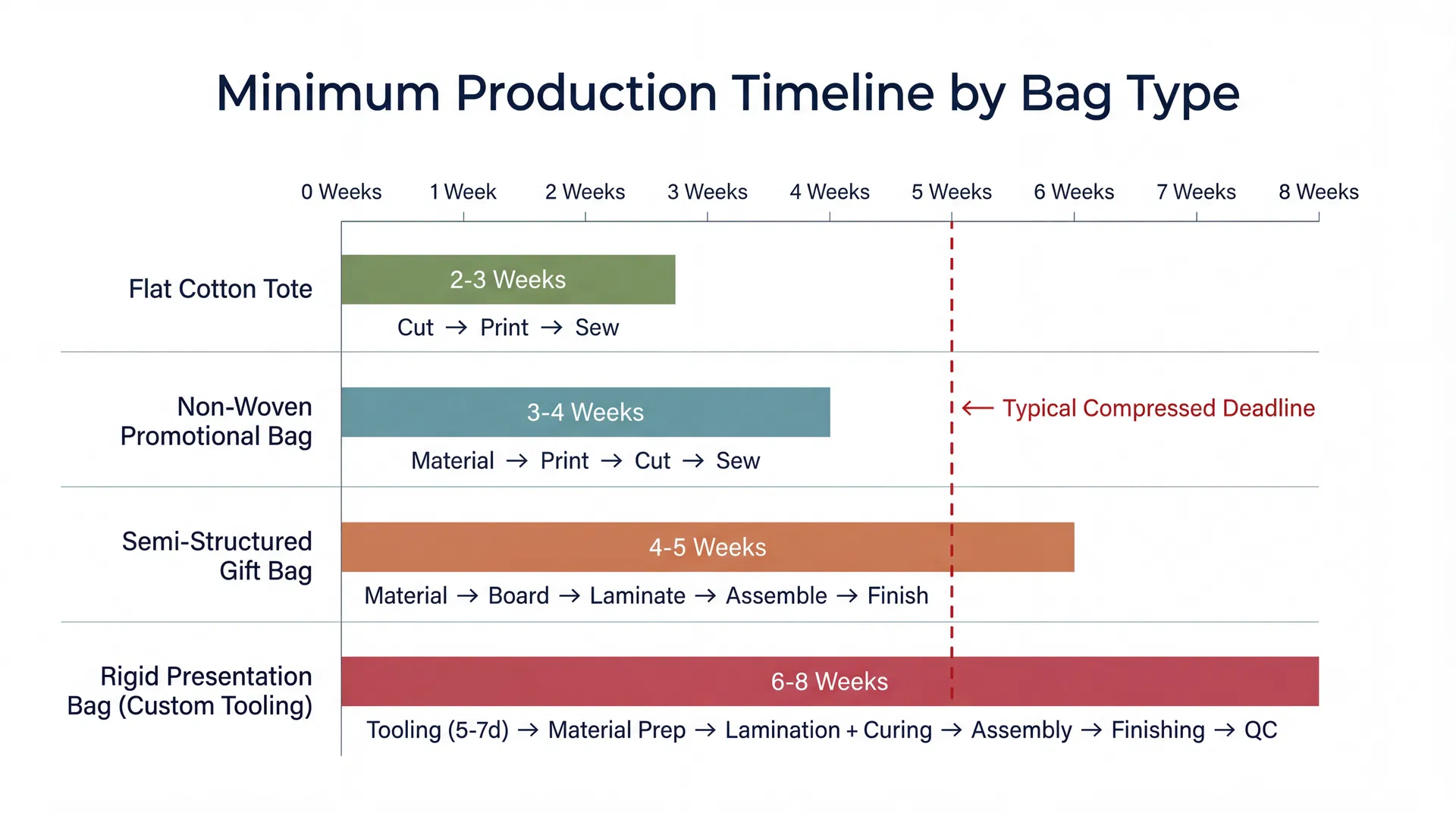
The mechanism is worth understanding in detail because it explains why so many corporate gift bag programmes end up delivering a product that bears little resemblance to the original brief. A structured presentation bag — the kind with rigid side panels, a reinforced base, and a magnetic or ribbon closure — requires a production sequence that includes die-cutting for the structural board, lamination of the exterior material to the board, assembly of multiple components (handles, closures, interior lining), and a finishing process that often involves foil stamping or debossing. Each of these stages has a minimum cycle time that cannot be compressed below a certain threshold without introducing quality defects. The die-cutting alone requires tooling that takes five to seven working days to fabricate. The lamination process requires curing time. The assembly is labour-intensive and sequential — you cannot assemble the closure before the panels are laminated, and you cannot laminate before the board is cut.
In total, a structured presentation bag typically requires six to eight weeks from confirmed artwork to finished goods, with the first two to three weeks consumed entirely by tooling, material preparation, and sampling. A flat cotton tote, by contrast, requires two to three weeks in total. The fabric is cut from stock rolls, the printing is applied in a single pass, and the sewing is straightforward. There is no tooling, no structural assembly, and no curing time. The production sequence is linear and each stage can begin almost immediately after the previous one completes.
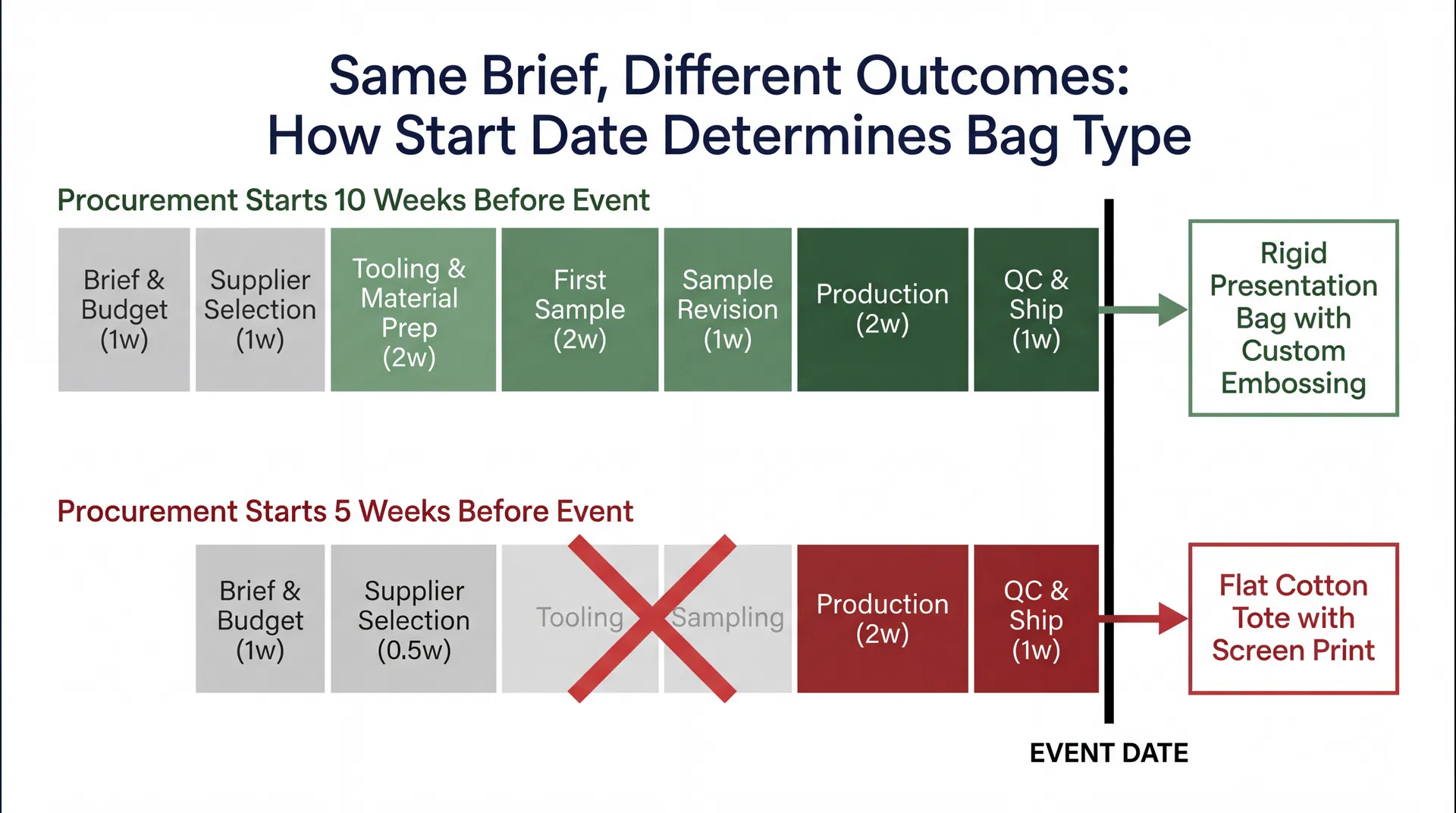
When a procurement team delays the order by three weeks — which happens routinely when internal approvals take longer than expected, when the brief undergoes revision, or when the budget confirmation is held up by a quarterly review cycle — the available production window shrinks from eight weeks to five. At five weeks, the structured presentation bag is no longer feasible. The tooling alone would consume more than half the remaining time, leaving insufficient margin for production, quality inspection, and shipping. The procurement team is now choosing from bag types that can be completed in five weeks or less: cotton totes, drawstring pouches, non-woven bags with simple printing, or at best a semi-structured bag using pre-existing tooling from a previous order.
In practice, this is often where corporate gift bag type decisions start to be misjudged, because the team does not experience the moment as a type elimination. They experience it as a supplier conversation about "what's achievable within the timeline." The supplier presents options that are feasible. The team selects from those options. The selection feels like a choice, but the choice set has already been narrowed by the timeline to exclude the types that would have served the programme's strategic objective. The structured presentation bag was never rejected. It was never evaluated. It simply ceased to be available.
The assumption that underlies this pattern is that production speed is primarily a function of supplier capability and willingness — that a sufficiently motivated or well-resourced factory can produce any bag type faster if the order is important enough. This assumption holds for certain variables. A factory can expedite material procurement by paying premium prices for faster delivery. It can allocate additional labour to accelerate sewing and assembly. It can prioritise an order in the production queue by rescheduling other work. But it cannot compress the physical curing time of adhesive lamination. It cannot fabricate precision die-cutting tools in two days instead of five. It cannot skip the sample approval stage without accepting the risk that the finished product will not match the client's expectations — a risk that, for a corporate gift programme intended to impress clients, is rarely acceptable.
The sample approval stage deserves particular attention because it is the element most frequently underestimated in compressed timelines. For a structured bag with custom tooling, the first sample typically takes ten to fourteen working days to produce. The client reviews the sample, requests adjustments — the colour is slightly off, the handle attachment point needs to move five millimetres, the logo debossing depth is insufficient — and a revised sample takes another seven to ten days. This cycle is not optional. It is the mechanism by which the client confirms that the finished product will meet their expectations. When the timeline is compressed, procurement teams often attempt to skip or abbreviate this cycle, either by approving the first sample without revision or by approving based on digital renders rather than physical samples. Both approaches introduce significant risk. A bag that looks correct in a render may feel wrong in the hand — the weight, the texture, the way the closure operates, the sound it makes when opened. These are tactile qualities that matter enormously for a corporate gift intended to create a premium impression, and they cannot be evaluated from a screen.
The consequence is a predictable bifurcation in outcomes. Programmes that begin procurement early enough to accommodate the full production timeline for their preferred bag type tend to receive products that match their strategic intent. Programmes that begin late — even by a few weeks — tend to receive products from a narrower category of simpler constructions, regardless of what the original brief specified. The budget may be identical. The brand guidelines may be identical. The supplier may be identical. The only variable that changed was time, and that single variable determined the bag type.
There is a secondary effect that compounds this problem. When a procurement team receives a simpler bag type than originally envisioned, they often rationalise the outcome rather than recognising it as a timeline-driven compromise. The cotton tote becomes "more practical" or "more aligned with our sustainability messaging" or "what recipients actually prefer." These rationalisations are not necessarily wrong — a cotton tote may indeed be practical and sustainable — but they obscure the fact that the type selection was not a strategic decision. It was a constraint-driven default. And when the same programme runs the following year, the team references the previous year's "decision" to use cotton totes as precedent, further entrenching a type selection that was never deliberately made. Understanding [which corporate gift bag types serve different business objectives](/blog/which-types-of-corporate-gifts-are-best-for-different-business-needs) becomes difficult when the organisation's own procurement history is populated with constraint-driven defaults rather than strategic selections.
The practical implication is that bag type selection and procurement timeline are not independent variables. They are coupled, and the coupling is asymmetric. Extending the timeline opens up more bag types. Compressing the timeline eliminates them. A procurement team that wants genuine freedom to select the bag type that best serves their programme's objective needs to begin the process early enough that the most complex feasible type remains available — even if they ultimately choose a simpler option. The difference between choosing a cotton tote because it is the right type for the occasion and defaulting to a cotton tote because nothing else can be produced in time is the difference between a strategic procurement decision and an administrative one. The bag may look the same. The programme outcome will not.