Why Your Brand Guidelines Are Quietly Choosing Your Corporate Gift Bag Type Before You Do
Brand guideline specifications — logo size, Pantone matching, clear space rules, and typography restrictions — were designed for print and digital media. When applied as the first filter in corporate gift bag procurement, they systematically eliminate structured bag types before strategic assessment begins.
· By BritBag Works
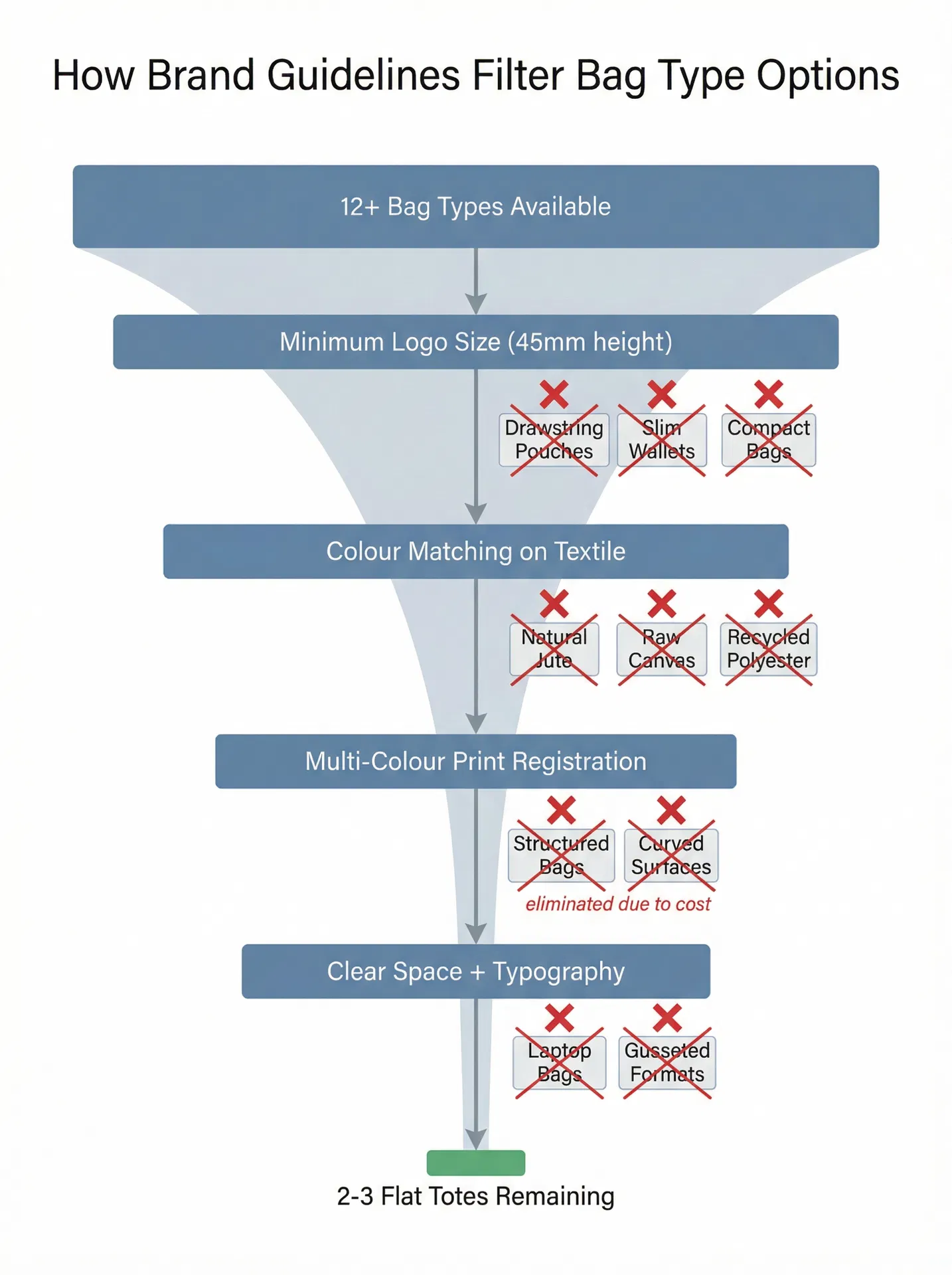 What happens next is a process of elimination that most procurement teams never witness. The brand book specifies a minimum logo reproduction size of, say, 45 millimetres in height. This single requirement immediately removes every bag format where the primary imprint area cannot accommodate that dimension with the mandated clear space around it. Drawstring pouches, slim document wallets, compact cosmetic bags, and single-bottle wine carriers all fall away — not because they would fail as corporate gifts, but because the logo cannot be printed at the required size on their available surface area. The procurement team sees a shortlist of three or four bag types and assumes those were the only viable options. They were not. They were simply the only options that survived the brand filter.
Colour matching introduces a second layer of invisible elimination. Corporate brand guidelines specify Pantone values that were calibrated for coated paper stock or digital RGB rendering. When those same values are applied to textile substrates, the physics change entirely. A deep navy that renders cleanly on coated stock may shift perceptibly on natural cotton, appear muddy on recycled polyester, or prove impossible to match on raw jute. The factory knows this from the first sample request, but the brand team evaluates samples against their digital reference file and rejects anything that does not match precisely. The result is that material options narrow to whichever substrate happens to hold the specified colour most faithfully — typically smooth, bleached, or pre-treated fabrics — which in turn restricts the bag types available. A structured canvas holdall that would have been the ideal gift for a senior client event gets eliminated because the brand's signature teal cannot be reproduced on heavyweight canvas to the satisfaction of the brand compliance reviewer.
The multi-colour dimension of this problem deserves particular attention because it operates as a cost multiplier that further constrains bag type selection. A corporate logo with four distinct Pantone colours requires four separate screen printing plates, each adding setup cost and production time. On a simple flat tote with a large, uninterrupted front panel, four-colour screen printing is straightforward. On a structured bag with multiple panels, curved surfaces, or textured materials, each additional colour increases the risk of registration errors — where colours do not align precisely — and the reject rate climbs accordingly. The factory calculates this risk into the quotation, and suddenly the per-unit cost for the structured bag that would have been the right strategic choice exceeds the budget ceiling. The procurement team sees a price problem. The factory sees a brand specification problem. Neither recognises that the four-colour logo requirement, not the bag type itself, is driving the cost differential.
Typography restrictions compound the problem in ways that are particularly difficult to explain to non-manufacturing stakeholders. Brand guidelines frequently mandate specific typefaces — often elegant serifs or thin-weight sans-serifs chosen for their sophistication on screen. On textile printing, fine serifs and hairline strokes require line weights below the minimum threshold for clean reproduction. Screen printing on canvas demands a minimum two-point line weight; anything thinner bleeds, fills in, or disappears entirely depending on the fabric weave. When the brand-approved typeface cannot be reproduced on a given material, that material is disqualified, and with it every bag type constructed from it. The factory does not make this decision arbitrarily — it is a physical constraint of the printing process — but the procurement team experiences it as a mysterious shrinking of options.
The clear space rule is perhaps the most underestimated specification in the entire brand document. Most corporate brand guidelines require a minimum clear zone around the logo — typically 1.5 to 2 times the logo height on all sides. On a flat printed page, this is trivial. On a three-dimensional bag with seams, gussets, handles, zippers, and structural panels, the clear space requirement can consume the entire usable imprint area. A structured laptop bag with a front panel of 25 by 18 centimetres might seem to offer generous branding space, but once the logo is placed at minimum size with mandated clear space, and the seam margins and handle attachment points are excluded, the remaining area may be insufficient. The bag type is disqualified not because it is wrong for the business purpose but because the brand guidelines were never calibrated for three-dimensional textile products.
What makes this pattern particularly persistent is the sample approval cycle it generates. The factory produces a first sample on the bag type that best fits the strategic brief, knowing that the brand specifications will be difficult to satisfy on that format. The brand team rejects the sample — the colour is half a shade off, the logo clear space encroaches on a seam line, the typeface detail is lost in the fabric texture. A second sample is attempted with adjustments, and it too falls short of the brand standard. By the third rejection, the factory suggests an alternative bag type — typically a simpler format with a larger, flatter printing surface — and the brand team approves it immediately. The procurement team interprets this as the factory finding the right solution. From the production floor, it looks quite different: the factory abandoned the strategically correct bag type and defaulted to the one that was easiest to brand-comply, regardless of whether it served the original business purpose.
What happens next is a process of elimination that most procurement teams never witness. The brand book specifies a minimum logo reproduction size of, say, 45 millimetres in height. This single requirement immediately removes every bag format where the primary imprint area cannot accommodate that dimension with the mandated clear space around it. Drawstring pouches, slim document wallets, compact cosmetic bags, and single-bottle wine carriers all fall away — not because they would fail as corporate gifts, but because the logo cannot be printed at the required size on their available surface area. The procurement team sees a shortlist of three or four bag types and assumes those were the only viable options. They were not. They were simply the only options that survived the brand filter.
Colour matching introduces a second layer of invisible elimination. Corporate brand guidelines specify Pantone values that were calibrated for coated paper stock or digital RGB rendering. When those same values are applied to textile substrates, the physics change entirely. A deep navy that renders cleanly on coated stock may shift perceptibly on natural cotton, appear muddy on recycled polyester, or prove impossible to match on raw jute. The factory knows this from the first sample request, but the brand team evaluates samples against their digital reference file and rejects anything that does not match precisely. The result is that material options narrow to whichever substrate happens to hold the specified colour most faithfully — typically smooth, bleached, or pre-treated fabrics — which in turn restricts the bag types available. A structured canvas holdall that would have been the ideal gift for a senior client event gets eliminated because the brand's signature teal cannot be reproduced on heavyweight canvas to the satisfaction of the brand compliance reviewer.
The multi-colour dimension of this problem deserves particular attention because it operates as a cost multiplier that further constrains bag type selection. A corporate logo with four distinct Pantone colours requires four separate screen printing plates, each adding setup cost and production time. On a simple flat tote with a large, uninterrupted front panel, four-colour screen printing is straightforward. On a structured bag with multiple panels, curved surfaces, or textured materials, each additional colour increases the risk of registration errors — where colours do not align precisely — and the reject rate climbs accordingly. The factory calculates this risk into the quotation, and suddenly the per-unit cost for the structured bag that would have been the right strategic choice exceeds the budget ceiling. The procurement team sees a price problem. The factory sees a brand specification problem. Neither recognises that the four-colour logo requirement, not the bag type itself, is driving the cost differential.
Typography restrictions compound the problem in ways that are particularly difficult to explain to non-manufacturing stakeholders. Brand guidelines frequently mandate specific typefaces — often elegant serifs or thin-weight sans-serifs chosen for their sophistication on screen. On textile printing, fine serifs and hairline strokes require line weights below the minimum threshold for clean reproduction. Screen printing on canvas demands a minimum two-point line weight; anything thinner bleeds, fills in, or disappears entirely depending on the fabric weave. When the brand-approved typeface cannot be reproduced on a given material, that material is disqualified, and with it every bag type constructed from it. The factory does not make this decision arbitrarily — it is a physical constraint of the printing process — but the procurement team experiences it as a mysterious shrinking of options.
The clear space rule is perhaps the most underestimated specification in the entire brand document. Most corporate brand guidelines require a minimum clear zone around the logo — typically 1.5 to 2 times the logo height on all sides. On a flat printed page, this is trivial. On a three-dimensional bag with seams, gussets, handles, zippers, and structural panels, the clear space requirement can consume the entire usable imprint area. A structured laptop bag with a front panel of 25 by 18 centimetres might seem to offer generous branding space, but once the logo is placed at minimum size with mandated clear space, and the seam margins and handle attachment points are excluded, the remaining area may be insufficient. The bag type is disqualified not because it is wrong for the business purpose but because the brand guidelines were never calibrated for three-dimensional textile products.
What makes this pattern particularly persistent is the sample approval cycle it generates. The factory produces a first sample on the bag type that best fits the strategic brief, knowing that the brand specifications will be difficult to satisfy on that format. The brand team rejects the sample — the colour is half a shade off, the logo clear space encroaches on a seam line, the typeface detail is lost in the fabric texture. A second sample is attempted with adjustments, and it too falls short of the brand standard. By the third rejection, the factory suggests an alternative bag type — typically a simpler format with a larger, flatter printing surface — and the brand team approves it immediately. The procurement team interprets this as the factory finding the right solution. From the production floor, it looks quite different: the factory abandoned the strategically correct bag type and defaulted to the one that was easiest to brand-comply, regardless of whether it served the original business purpose.
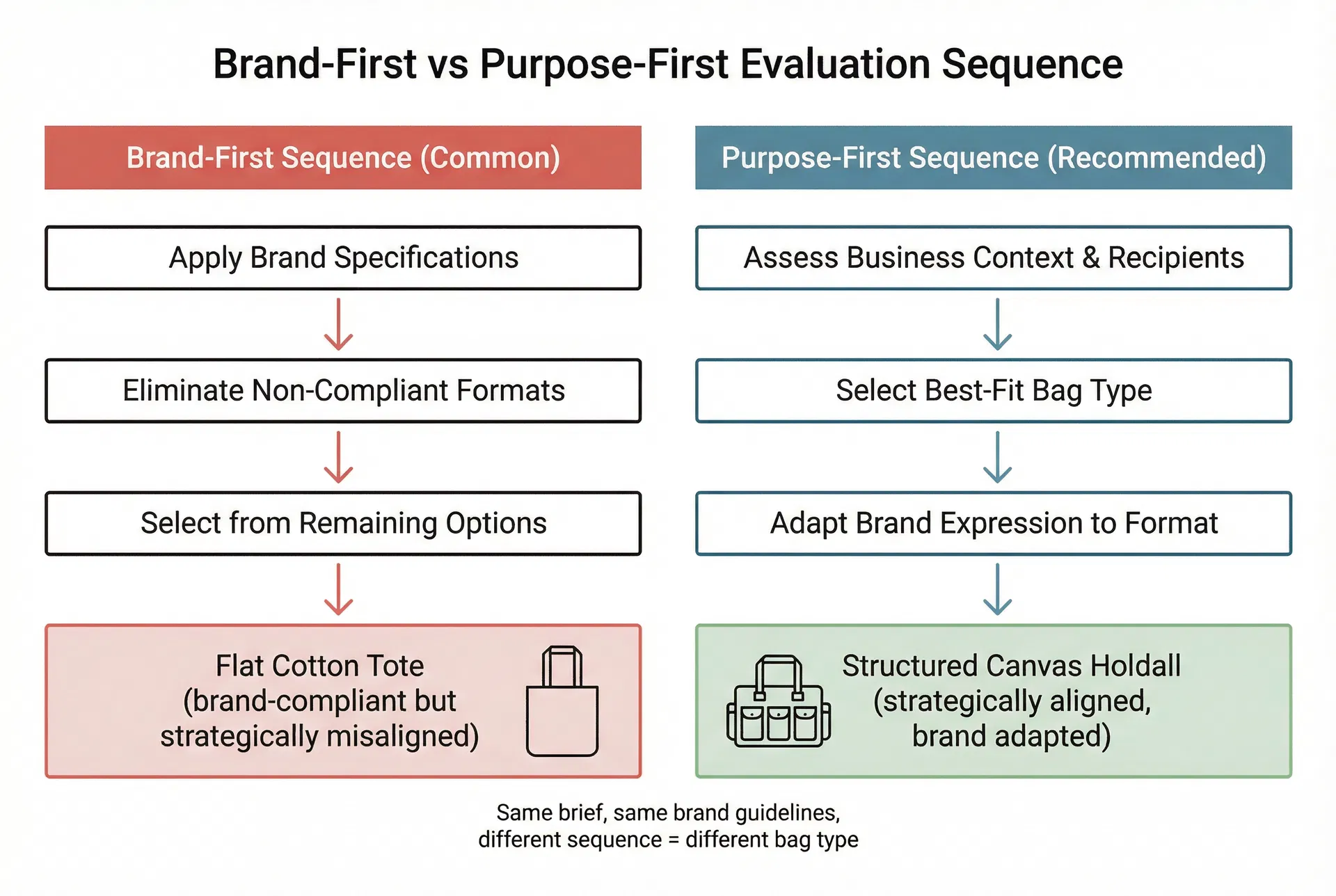 In practice, this is often where corporate gift bag type decisions start to go sideways. The procurement team believes they are choosing the best bag type for their business need, but the actual selection has already been made by a brand compliance document that was never intended to serve as a product specification tool. The factory sees this repeatedly: a brief that clearly calls for a structured, premium bag arrives with brand guidelines that can only be satisfied by a flat cotton tote. The tote gets produced, the brand team approves it, and the recipients receive something that looks correct on paper but feels entirely wrong for the occasion. Understanding how different bag types serve distinct business contexts requires separating the brand compliance question from the strategic fit question — and addressing them in the correct sequence.
The deeper issue is one of sequencing. When brand compliance is applied as the first filter, it operates as a constraint that narrows options before strategic assessment begins. When it is applied after the bag type has been selected for strategic fit, it becomes a design challenge — how to adapt the brand expression to the chosen format — rather than a selection criterion. A skilled factory can adjust logo placement, modify reproduction techniques, propose alternative colourways within the brand palette, or suggest material treatments that improve colour fidelity. But these adaptations only become possible when the bag type is selected first and the brand expression is engineered to fit it, rather than the other way around.
The problem is compounded when organisations operate across multiple sub-brands or regional divisions, each with its own variant of the master brand guidelines. A parent company may permit a broader colour palette at the group level, but the division placing the gift bag order works from a restricted subset — perhaps only two of the six approved Pantone values. Those two colours may reproduce well on paper and screen but interact poorly with the dye chemistry of natural textile fibres. The factory receives the restricted palette and immediately recognises that the material options have narrowed to synthetic substrates, which in turn limits the bag construction methods available. A structured jute holdall that would have been the ideal premium gift becomes impossible — not because of any manufacturing limitation, but because the divisional brand palette was never tested against textile reproduction constraints.
There is also a temporal dimension to this problem that procurement teams rarely consider. Brand guidelines are living documents that evolve over time, but the version attached to a gift bag brief may be months or even years out of date. A brand refresh that simplified the logo, reduced the colour count, or relaxed the clear space requirements may have been completed since the brief was drafted, but the procurement team works from the version they have on file. The factory quotes and samples against specifications that the brand team has already moved beyond, creating a phantom constraint that eliminates bag types unnecessarily. By the time the discrepancy is discovered — if it is discovered at all — the production timeline has already narrowed the available options to whatever can be manufactured fastest, which is almost never the strategically optimal choice.
The most telling indicator of this problem is when a procurement team reports that "there weren't many options" for their programme. In most cases, there were dozens of options. The brand guidelines simply eliminated them before anyone noticed. The factory's sample room is full of bag types that were never presented to the client because the brand book made them technically non-compliant at the specification stage. This is not a failure of manufacturing capability or supplier range. It is a sequencing error in the evaluation process — one that consistently produces bags that satisfy the brand team but underperform against the actual business objective they were meant to serve.
In practice, this is often where corporate gift bag type decisions start to go sideways. The procurement team believes they are choosing the best bag type for their business need, but the actual selection has already been made by a brand compliance document that was never intended to serve as a product specification tool. The factory sees this repeatedly: a brief that clearly calls for a structured, premium bag arrives with brand guidelines that can only be satisfied by a flat cotton tote. The tote gets produced, the brand team approves it, and the recipients receive something that looks correct on paper but feels entirely wrong for the occasion. Understanding how different bag types serve distinct business contexts requires separating the brand compliance question from the strategic fit question — and addressing them in the correct sequence.
The deeper issue is one of sequencing. When brand compliance is applied as the first filter, it operates as a constraint that narrows options before strategic assessment begins. When it is applied after the bag type has been selected for strategic fit, it becomes a design challenge — how to adapt the brand expression to the chosen format — rather than a selection criterion. A skilled factory can adjust logo placement, modify reproduction techniques, propose alternative colourways within the brand palette, or suggest material treatments that improve colour fidelity. But these adaptations only become possible when the bag type is selected first and the brand expression is engineered to fit it, rather than the other way around.
The problem is compounded when organisations operate across multiple sub-brands or regional divisions, each with its own variant of the master brand guidelines. A parent company may permit a broader colour palette at the group level, but the division placing the gift bag order works from a restricted subset — perhaps only two of the six approved Pantone values. Those two colours may reproduce well on paper and screen but interact poorly with the dye chemistry of natural textile fibres. The factory receives the restricted palette and immediately recognises that the material options have narrowed to synthetic substrates, which in turn limits the bag construction methods available. A structured jute holdall that would have been the ideal premium gift becomes impossible — not because of any manufacturing limitation, but because the divisional brand palette was never tested against textile reproduction constraints.
There is also a temporal dimension to this problem that procurement teams rarely consider. Brand guidelines are living documents that evolve over time, but the version attached to a gift bag brief may be months or even years out of date. A brand refresh that simplified the logo, reduced the colour count, or relaxed the clear space requirements may have been completed since the brief was drafted, but the procurement team works from the version they have on file. The factory quotes and samples against specifications that the brand team has already moved beyond, creating a phantom constraint that eliminates bag types unnecessarily. By the time the discrepancy is discovered — if it is discovered at all — the production timeline has already narrowed the available options to whatever can be manufactured fastest, which is almost never the strategically optimal choice.
The most telling indicator of this problem is when a procurement team reports that "there weren't many options" for their programme. In most cases, there were dozens of options. The brand guidelines simply eliminated them before anyone noticed. The factory's sample room is full of bag types that were never presented to the client because the brand book made them technically non-compliant at the specification stage. This is not a failure of manufacturing capability or supplier range. It is a sequencing error in the evaluation process — one that consistently produces bags that satisfy the brand team but underperform against the actual business objective they were meant to serve.