Why Your Corporate Gift Bag Sample Is Choosing the Wrong Bag Type for You
The pre-production sample creates a systematic bias in corporate gift bag type selection. The structured bag your team approved was made under conditions that production cannot replicate — and the gap between sample and production varies dramatically by bag type complexity.
· By BritBag Works
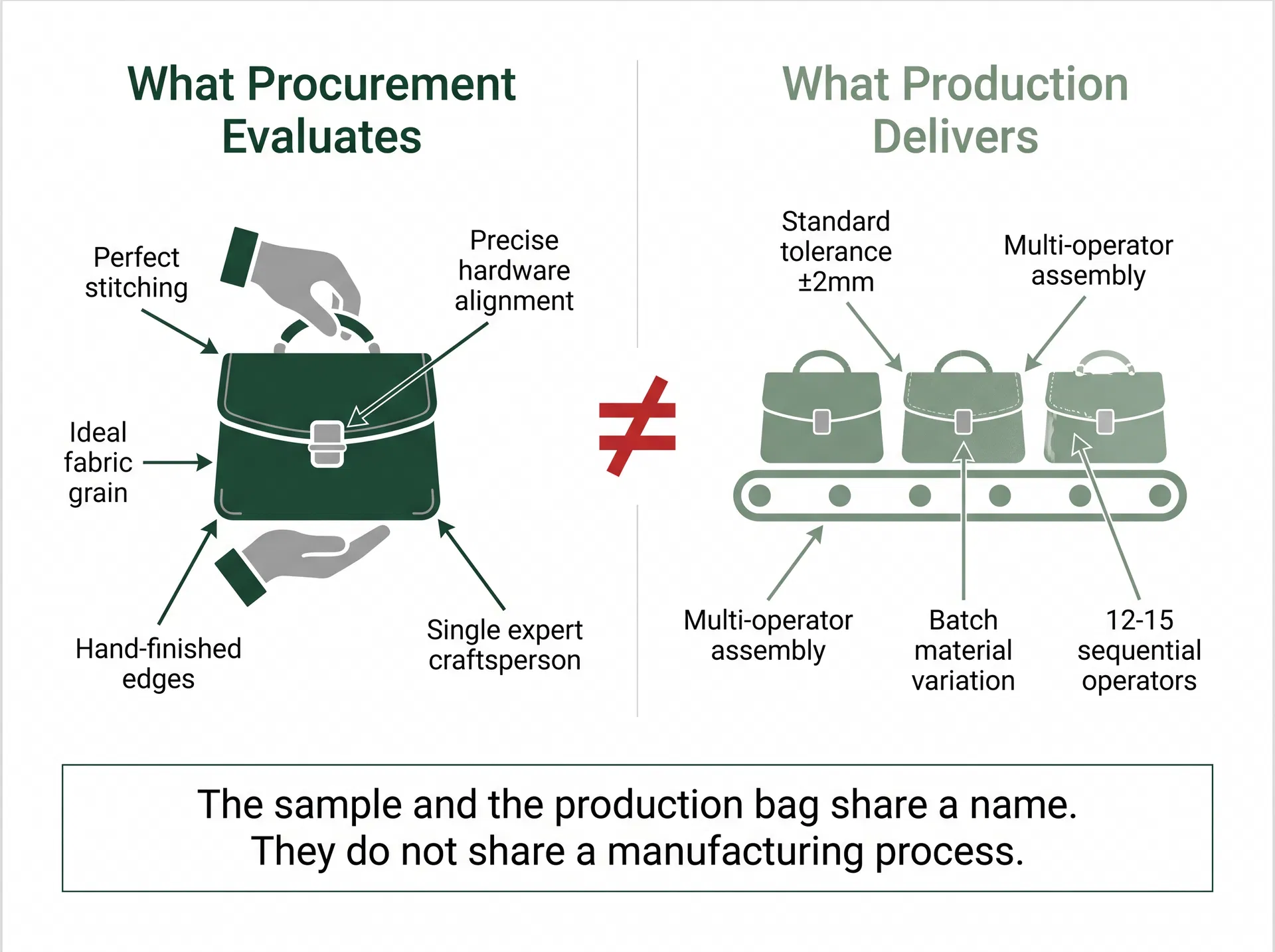 This is not a quality control problem. It is not about the production batch being slightly worse than the sample. It is a type selection problem — the sample causes the procurement team to believe they are choosing between bag types based on evidence, when in fact the evidence they are evaluating was produced by a fundamentally different manufacturing process than the one that will deliver their order. The structured messenger bag they approved as a sample was made by a single senior pattern maker over two to three days, with continuous manual adjustments at every stage. The structured messenger bag that arrives in production is assembled by twelve to fifteen operators on a sequential line, each performing one isolated step without visibility of the finished product. These are not the same bag type in any meaningful manufacturing sense, even though they share a name on the brief.
The divergence begins at the cutting stage. When a sample room produces a corporate gift bag, the pattern maker selects fabric from a single roll — typically the best section of that roll, avoiding any weave irregularities, colour variation, or surface inconsistencies. They position the pattern pieces to optimise grain direction, ensuring that the bag's panels sit correctly when assembled. In production, fabric is cut in stacks of forty to sixty layers using a band knife or die cutter. The operator cannot inspect each layer for irregularities. Grain direction is maintained as closely as possible, but the tolerance is wider — two to three degrees of variation is standard. On an unstructured tote bag, this variation is invisible. On a structured bag with rigid panels and precise seam alignment, it produces subtle distortion that accumulates across the bag's surface. The procurement team evaluated a sample where every panel was cut from perfect fabric in perfect alignment. The production version of that same bag type will have panels that are technically within tolerance but visibly less precise. The bag type has not changed on paper. The bag in hand is a different product.
The assembly sequence introduces a second layer of divergence that is specific to bag type selection. Complex bag types — those with internal frames, multiple compartments, reinforced bases, and structured closures — require a specific assembly order where each step depends on the precision of the previous one. In the sample room, the pattern maker performs all steps sequentially, holding the emerging bag in their hands throughout, making micro-adjustments as they go. If a panel is sitting slightly off-angle after the first seam, they compensate in the next operation. This continuous correction produces a bag that appears perfectly constructed because it was continuously corrected throughout construction. In production, each operator performs their single step and passes the work to the next station. There is no continuous correction. If the first seam is 1.5 millimetres off-centre — within the standard production tolerance of plus or minus two millimetres — that deviation carries forward through every subsequent operation. By the time the bag reaches the final assembly stage, the accumulated deviation may be five to eight millimetres, which on a structured bag produces visible asymmetry. The procurement team's sample showed them what a structured messenger bag looks like when continuously corrected by a single expert. Production shows them what the same bag type looks like when assembled by a sequential process without correction. They are evaluating a type that only exists under sample-room conditions.
Hardware installation demonstrates this divergence most clearly. Custom corporate gift bags frequently specify branded zip pulls, magnetic closures, or metal hardware that requires precise positioning. In the sample room, the pattern maker marks each hardware position individually, drilling or punching at exact coordinates. If the first attempt is slightly off, they can reposition — the sample allows for this because there is only one unit. In production, hardware positions are marked by jig or template, and the operator installs hardware on hundreds of units per day. The jig has a tolerance of plus or minus one millimetre. On a flat tote bag, one millimetre of hardware variation is invisible. On a structured portfolio bag where the magnetic closure must align precisely with a reinforced flap, one millimetre of variation means the closure does not sit flush, the flap pulls slightly to one side, or the snap requires more force than intended. The procurement team approved a sample where the hardware was positioned with single-unit precision. The production version uses the same hardware in the same nominal position, but the installation tolerance changes the functional behaviour of the bag. The bag type — a structured portfolio with magnetic closure — becomes a bag that technically has a magnetic closure but does not close with the same satisfying precision that the sample demonstrated.
The material behaviour itself shifts between sample and production in ways that affect type perception. When a sample is made, the pattern maker works with a small quantity of fabric that has been stored flat, at consistent temperature and humidity, often for only a few days between cutting and assembly. The fabric behaves predictably. In production, fabric may be stored on rolls for weeks before cutting, compressed under its own weight, exposed to varying humidity levels in the factory. Certain materials — particularly natural fibres like cotton canvas and jute — absorb moisture and change dimension by one to two per cent between storage conditions. A structured bag designed with precise panel dimensions in the sample room may have panels that are fractionally larger or smaller in production, depending on storage conditions. The bag type still looks correct in photographs. In hand, it feels different — slightly looser, slightly less defined, slightly less structured than the sample suggested it would be.
This is not a quality control problem. It is not about the production batch being slightly worse than the sample. It is a type selection problem — the sample causes the procurement team to believe they are choosing between bag types based on evidence, when in fact the evidence they are evaluating was produced by a fundamentally different manufacturing process than the one that will deliver their order. The structured messenger bag they approved as a sample was made by a single senior pattern maker over two to three days, with continuous manual adjustments at every stage. The structured messenger bag that arrives in production is assembled by twelve to fifteen operators on a sequential line, each performing one isolated step without visibility of the finished product. These are not the same bag type in any meaningful manufacturing sense, even though they share a name on the brief.
The divergence begins at the cutting stage. When a sample room produces a corporate gift bag, the pattern maker selects fabric from a single roll — typically the best section of that roll, avoiding any weave irregularities, colour variation, or surface inconsistencies. They position the pattern pieces to optimise grain direction, ensuring that the bag's panels sit correctly when assembled. In production, fabric is cut in stacks of forty to sixty layers using a band knife or die cutter. The operator cannot inspect each layer for irregularities. Grain direction is maintained as closely as possible, but the tolerance is wider — two to three degrees of variation is standard. On an unstructured tote bag, this variation is invisible. On a structured bag with rigid panels and precise seam alignment, it produces subtle distortion that accumulates across the bag's surface. The procurement team evaluated a sample where every panel was cut from perfect fabric in perfect alignment. The production version of that same bag type will have panels that are technically within tolerance but visibly less precise. The bag type has not changed on paper. The bag in hand is a different product.
The assembly sequence introduces a second layer of divergence that is specific to bag type selection. Complex bag types — those with internal frames, multiple compartments, reinforced bases, and structured closures — require a specific assembly order where each step depends on the precision of the previous one. In the sample room, the pattern maker performs all steps sequentially, holding the emerging bag in their hands throughout, making micro-adjustments as they go. If a panel is sitting slightly off-angle after the first seam, they compensate in the next operation. This continuous correction produces a bag that appears perfectly constructed because it was continuously corrected throughout construction. In production, each operator performs their single step and passes the work to the next station. There is no continuous correction. If the first seam is 1.5 millimetres off-centre — within the standard production tolerance of plus or minus two millimetres — that deviation carries forward through every subsequent operation. By the time the bag reaches the final assembly stage, the accumulated deviation may be five to eight millimetres, which on a structured bag produces visible asymmetry. The procurement team's sample showed them what a structured messenger bag looks like when continuously corrected by a single expert. Production shows them what the same bag type looks like when assembled by a sequential process without correction. They are evaluating a type that only exists under sample-room conditions.
Hardware installation demonstrates this divergence most clearly. Custom corporate gift bags frequently specify branded zip pulls, magnetic closures, or metal hardware that requires precise positioning. In the sample room, the pattern maker marks each hardware position individually, drilling or punching at exact coordinates. If the first attempt is slightly off, they can reposition — the sample allows for this because there is only one unit. In production, hardware positions are marked by jig or template, and the operator installs hardware on hundreds of units per day. The jig has a tolerance of plus or minus one millimetre. On a flat tote bag, one millimetre of hardware variation is invisible. On a structured portfolio bag where the magnetic closure must align precisely with a reinforced flap, one millimetre of variation means the closure does not sit flush, the flap pulls slightly to one side, or the snap requires more force than intended. The procurement team approved a sample where the hardware was positioned with single-unit precision. The production version uses the same hardware in the same nominal position, but the installation tolerance changes the functional behaviour of the bag. The bag type — a structured portfolio with magnetic closure — becomes a bag that technically has a magnetic closure but does not close with the same satisfying precision that the sample demonstrated.
The material behaviour itself shifts between sample and production in ways that affect type perception. When a sample is made, the pattern maker works with a small quantity of fabric that has been stored flat, at consistent temperature and humidity, often for only a few days between cutting and assembly. The fabric behaves predictably. In production, fabric may be stored on rolls for weeks before cutting, compressed under its own weight, exposed to varying humidity levels in the factory. Certain materials — particularly natural fibres like cotton canvas and jute — absorb moisture and change dimension by one to two per cent between storage conditions. A structured bag designed with precise panel dimensions in the sample room may have panels that are fractionally larger or smaller in production, depending on storage conditions. The bag type still looks correct in photographs. In hand, it feels different — slightly looser, slightly less defined, slightly less structured than the sample suggested it would be.
 The finishing stage is where the type illusion becomes most complete. Sample bags receive individual finishing attention — loose threads are trimmed, edges are burnished by hand, any surface marks are cleaned, and the bag is stuffed with tissue to hold its shape during presentation to the client. This finishing creates the impression of a bag type that holds its form, presents cleanly, and has a premium tactile quality. In production, finishing is performed at line speed. Loose threads are trimmed, but edge burnishing may be simplified or omitted for cost efficiency. Surface marks from handling during assembly are not individually addressed unless they exceed the defect threshold. The bag is not stuffed — it is folded, poly-bagged, and packed into cartons. When the procurement team receives the production delivery and opens the first carton, the bags are flat, creased from packing, and require manual reshaping. The bag type they approved — a structured, self-standing holdall — is now a flat object that needs to be coaxed into shape. It will hold that shape once filled, but the first impression contradicts the type they believed they selected.
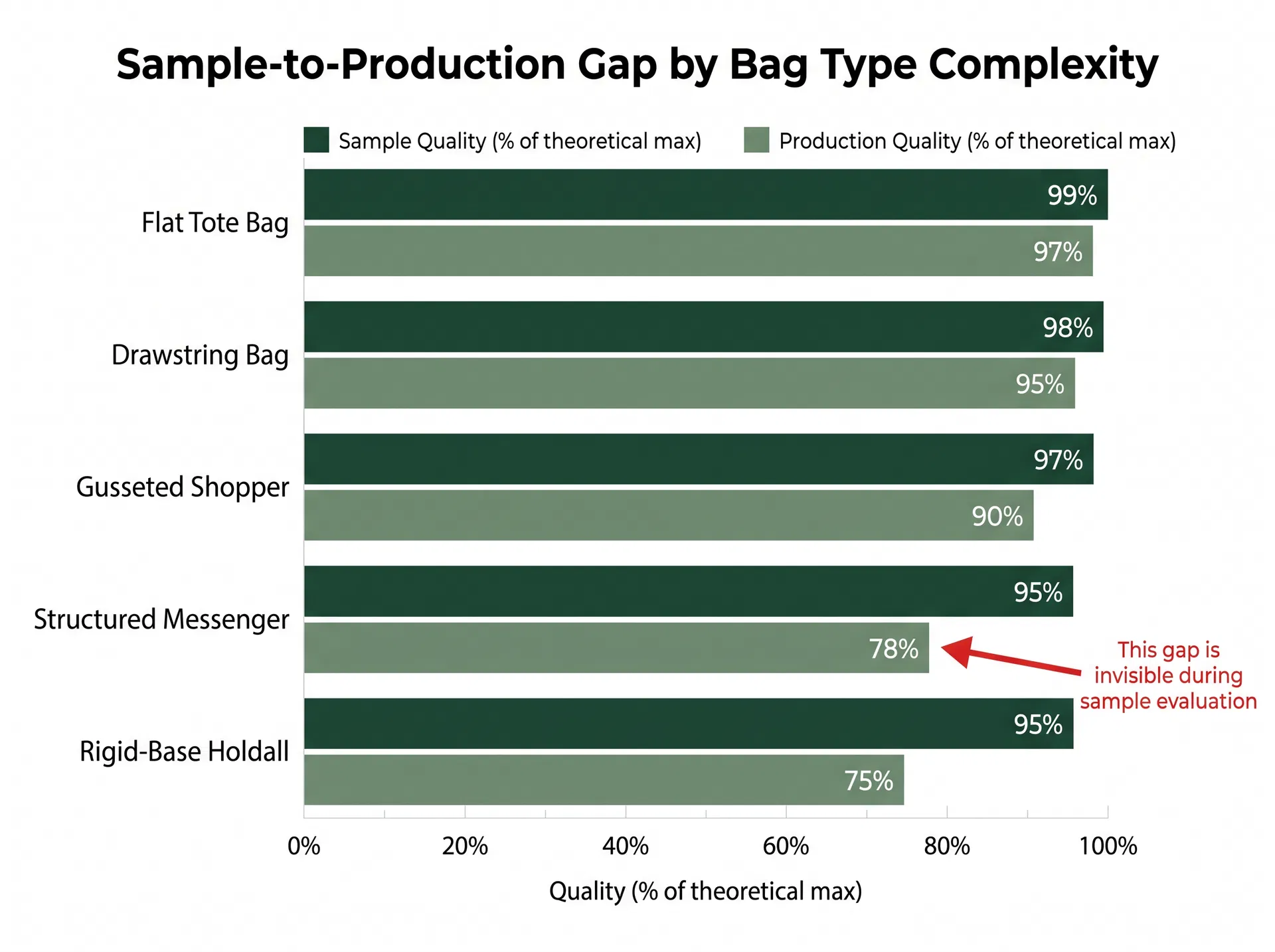
In practice, this is often where corporate gift bag type decisions start to be misjudged. The procurement team evaluates a sample that represents the theoretical maximum of what a bag type can be. They compare it against other samples — a tote, a drawstring, a messenger — each also representing its theoretical maximum. They select the type that best serves their business purpose based on these idealised representations. But the gap between sample and production is not uniform across bag types. Simple, unstructured bag types — totes, drawstrings, basic shoppers — have a very narrow gap between sample and production because they have fewer precision-dependent operations. Complex, structured bag types — messengers, holdalls, portfolios, laptop sleeves — have a wide gap because they depend on cumulative precision across many operations. The procurement team is unknowingly comparing bag types at different points on their respective sample-to-production curves. The structured messenger sample is showing them a bag that is ninety-five per cent of its theoretical maximum. The cotton tote sample is showing them a bag that is ninety-nine per cent of its theoretical maximum. In production, the messenger will deliver at seventy-five to eighty per cent of what the sample showed. The tote will deliver at ninety-seven per cent. If the procurement team had evaluated the bag types at their production-realistic levels rather than their sample-room levels, they might have made a different type selection entirely.
The practical consequence for corporate gift programmes is significant. When the production delivery arrives and the bags do not match the sample's precision, the procurement team faces a difficult conversation with internal stakeholders. The bags are technically within specification — no individual measurement exceeds the agreed tolerance. But the cumulative effect of multiple tolerances stacking produces a bag that feels different from the sample. The stakeholders who approved the programme based on the sample now question the procurement team's supplier selection. The factory is asked to explain the discrepancy. The explanation — that samples and production are different manufacturing systems — is technically accurate but commercially unsatisfying. The programme proceeds, but confidence is damaged, and the next programme brief often retreats to a simpler bag type not because it better serves the business need, but because simpler types have a narrower sample-to-production gap and therefore fewer surprises.
Understanding how different bag types serve distinct corporate gifting contexts requires accounting for this sample evaluation bias. The question is not which bag type looks best as a sample — they all look their best as samples. The question is which bag type will still serve the business purpose when produced at scale, within budget, on a production timeline, by a sequential manufacturing process that cannot replicate the continuous correction of a sample room. The procurement teams that navigate this successfully are those that evaluate samples not as finished products but as prototypes — understanding that the production version will be a percentage of what the sample demonstrates, and that percentage varies dramatically by bag type complexity. They ask the factory not just whether the sample can be produced, but what the production version will realistically look like, feel like, and function like at the specified volume. That question — rarely asked — is the one that prevents the most common type selection errors in corporate gift bag programmes.
The finishing stage is where the type illusion becomes most complete. Sample bags receive individual finishing attention — loose threads are trimmed, edges are burnished by hand, any surface marks are cleaned, and the bag is stuffed with tissue to hold its shape during presentation to the client. This finishing creates the impression of a bag type that holds its form, presents cleanly, and has a premium tactile quality. In production, finishing is performed at line speed. Loose threads are trimmed, but edge burnishing may be simplified or omitted for cost efficiency. Surface marks from handling during assembly are not individually addressed unless they exceed the defect threshold. The bag is not stuffed — it is folded, poly-bagged, and packed into cartons. When the procurement team receives the production delivery and opens the first carton, the bags are flat, creased from packing, and require manual reshaping. The bag type they approved — a structured, self-standing holdall — is now a flat object that needs to be coaxed into shape. It will hold that shape once filled, but the first impression contradicts the type they believed they selected.
In practice, this is often where corporate gift bag type decisions start to be misjudged. The procurement team evaluates a sample that represents the theoretical maximum of what a bag type can be. They compare it against other samples — a tote, a drawstring, a messenger — each also representing its theoretical maximum. They select the type that best serves their business purpose based on these idealised representations. But the gap between sample and production is not uniform across bag types. Simple, unstructured bag types — totes, drawstrings, basic shoppers — have a very narrow gap between sample and production because they have fewer precision-dependent operations. Complex, structured bag types — messengers, holdalls, portfolios, laptop sleeves — have a wide gap because they depend on cumulative precision across many operations. The procurement team is unknowingly comparing bag types at different points on their respective sample-to-production curves. The structured messenger sample is showing them a bag that is ninety-five per cent of its theoretical maximum. The cotton tote sample is showing them a bag that is ninety-nine per cent of its theoretical maximum. In production, the messenger will deliver at seventy-five to eighty per cent of what the sample showed. The tote will deliver at ninety-seven per cent. If the procurement team had evaluated the bag types at their production-realistic levels rather than their sample-room levels, they might have made a different type selection entirely.
The practical consequence for corporate gift programmes is significant. When the production delivery arrives and the bags do not match the sample's precision, the procurement team faces a difficult conversation with internal stakeholders. The bags are technically within specification — no individual measurement exceeds the agreed tolerance. But the cumulative effect of multiple tolerances stacking produces a bag that feels different from the sample. The stakeholders who approved the programme based on the sample now question the procurement team's supplier selection. The factory is asked to explain the discrepancy. The explanation — that samples and production are different manufacturing systems — is technically accurate but commercially unsatisfying. The programme proceeds, but confidence is damaged, and the next programme brief often retreats to a simpler bag type not because it better serves the business need, but because simpler types have a narrower sample-to-production gap and therefore fewer surprises.
Understanding how different bag types serve distinct corporate gifting contexts requires accounting for this sample evaluation bias. The question is not which bag type looks best as a sample — they all look their best as samples. The question is which bag type will still serve the business purpose when produced at scale, within budget, on a production timeline, by a sequential manufacturing process that cannot replicate the continuous correction of a sample room. The procurement teams that navigate this successfully are those that evaluate samples not as finished products but as prototypes — understanding that the production version will be a percentage of what the sample demonstrates, and that percentage varies dramatically by bag type complexity. They ask the factory not just whether the sample can be produced, but what the production version will realistically look like, feel like, and function like at the specified volume. That question — rarely asked — is the one that prevents the most common type selection errors in corporate gift bag programmes.