Why Your 'Last Chance to Make Changes' Isn't Actually the Last Chance—And Why That Matters for Your Custom Bag Order
The specification change window for custom bag orders operates as a cascade of freeze points, not a single deadline. Understanding this structure prevents costly misjudgements about when changes become expensive.
· By BritBag Works
There is a recurring pattern in custom bag procurement that creates unnecessary friction between buyers and factories. A procurement team receives confirmation that their order specifications have been approved and production will begin. Two weeks later, someone in the organisation requests a change—perhaps a different thread colour for the stitching, or a slight adjustment to the logo placement. The buyer contacts the factory expecting a straightforward modification, only to discover that the change will cost significantly more than anticipated, or that it will delay the entire order by several weeks. The buyer interprets this as the factory being difficult or inflexible. The factory interprets the buyer as not understanding how manufacturing works. Both interpretations miss the actual issue.
The specification change window in custom bag manufacturing does not operate as a single deadline after which changes become impossible. It operates as a cascade of multiple freeze points, each representing a different stage of commitment, and each carrying a different cost multiplier when changes are requested after that point has passed. Buyers who understand only that there is "a deadline for changes" are operating with an incomplete mental model that leads to predictable misjudgements about timing, cost, and factory responsiveness.
The first freeze point occurs at specification confirmation, when the buyer formally approves the technical requirements for the bag. This includes dimensions, materials, colours, hardware specifications, and branding elements. At this stage, changes are relatively inexpensive because the factory has not yet committed resources beyond documentation. The cost of a change at this point is primarily administrative—updating records, revising quotes, and communicating with internal teams. Most buyers understand this stage intuitively because it mirrors their own internal approval processes.
The second freeze point occurs at concept approval, typically when the buyer signs off on design drawings or technical illustrations. At this stage, the factory may have begun preliminary discussions with material suppliers and hardware vendors. Changes after concept approval require revising these discussions, potentially renegotiating terms, and updating all downstream documentation. The cost multiplier at this stage is typically two to three times the cost of a pre-specification change, though this remains manageable for most orders.
The third freeze point—and this is where buyer understanding typically breaks down—occurs at detailed design release. This is the point at which the factory issues technical documents to the production floor and begins coordinating with suppliers for material procurement. Changes after detailed design release trigger a cascade of downstream effects that buyers rarely anticipate. The factory must revise production documentation, communicate changes to multiple internal departments, and potentially renegotiate supplier commitments. The cost multiplier at this stage can reach five to ten times the cost of an early-stage change, depending on the nature of the modification.
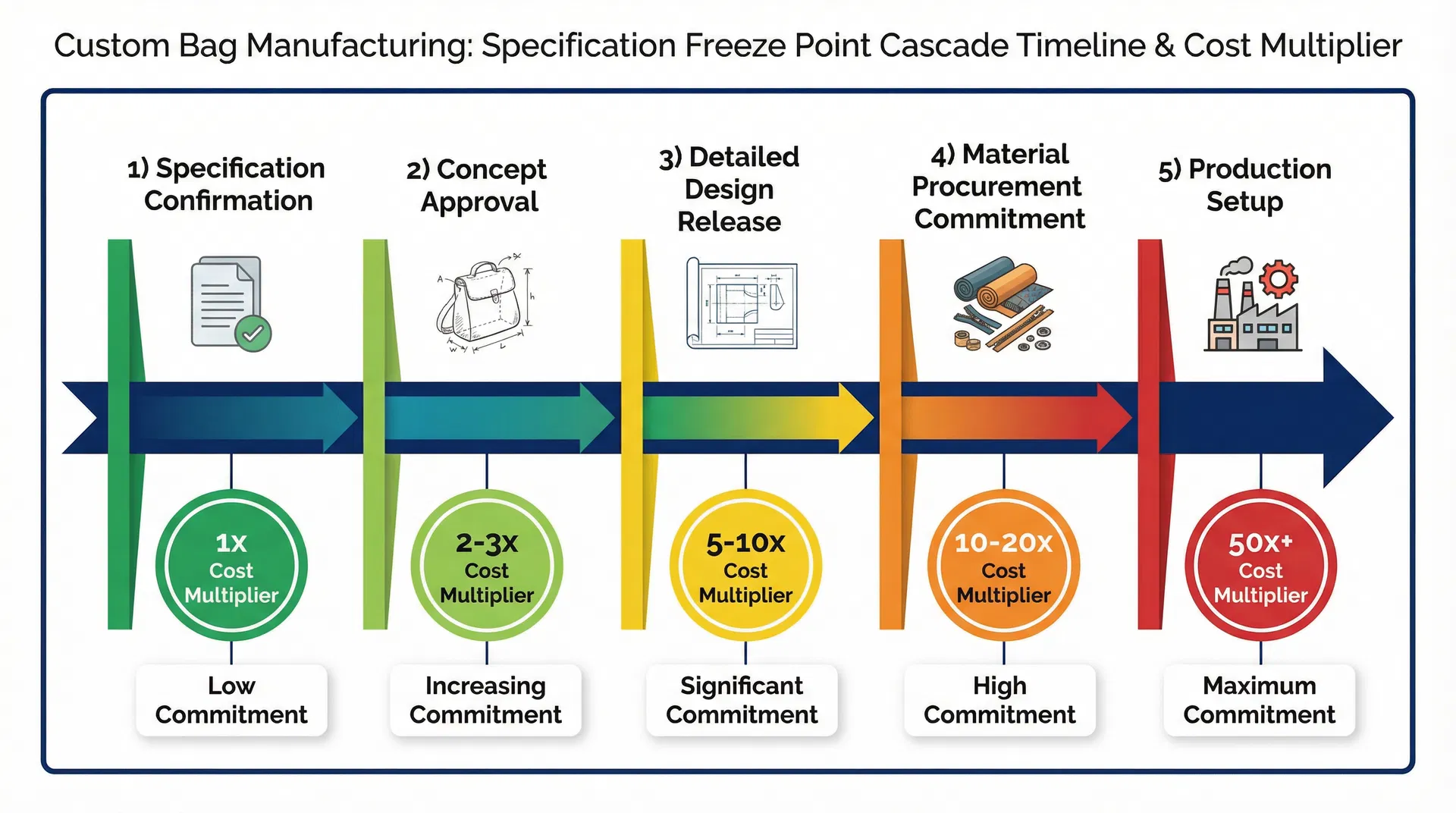
*The cascade of specification freeze points in custom bag manufacturing, showing how cost multipliers increase at each stage*
The fourth freeze point occurs at material procurement commitment. Once the factory has ordered fabrics, hardware, zippers, and other components, changes to specifications that affect these materials become significantly more expensive. The factory may have already paid deposits to suppliers, committed to minimum order quantities, or locked in pricing that cannot be easily reversed. A change to thread colour at this stage, for example, might seem trivial to the buyer but could require the factory to absorb the cost of thread already ordered, pay expedited shipping for replacement thread, and potentially delay production while waiting for the new materials. The cost multiplier at this stage can reach ten to twenty times the cost of an early-stage change.
The fifth and final freeze point occurs at production setup. Once the factory has configured production lines, trained operators on the specific requirements of the order, and begun cutting materials, changes become extraordinarily expensive. At this stage, any modification requires stopping production, reconfiguring equipment, potentially scrapping materials already cut or assembled, and restarting the entire process. The cost multiplier at this stage can exceed fifty times the cost of an early-stage change, and in some cases, the factory may simply refuse to accommodate the change because the disruption to their production schedule affects other customers' orders.
In practice, this is often where customization process decisions start to be misjudged. A buyer who understands only that there is "a deadline" for changes will often assume that any change requested before that deadline carries similar cost implications. They may not realise that a change requested one week before the stated deadline could cost ten times more than the same change requested three weeks earlier, simply because the factory has passed through additional freeze points during that interval.
The communication challenge compounds this problem. Factories typically communicate a single "deadline for changes" to buyers because explaining the full cascade of freeze points would require extensive education that most buyers do not want or need. The factory's simplified communication is well-intentioned but creates a gap between buyer expectations and manufacturing reality. When the buyer requests a change that they believe is "before the deadline" but the factory responds with a significant cost increase, the buyer often interprets this as the factory changing the rules or being unreasonable.
Understanding this cascade structure changes how buyers should approach the [stages of custom bag production](/blog/custom-bag-customization-process-uk-guide). Rather than thinking about changes in binary terms—possible or impossible, cheap or expensive—buyers should think about changes in terms of which freeze points have been passed. The question is not "can we make this change?" but rather "which freeze points has this order passed, and what are the cost implications of making this change at this stage?"
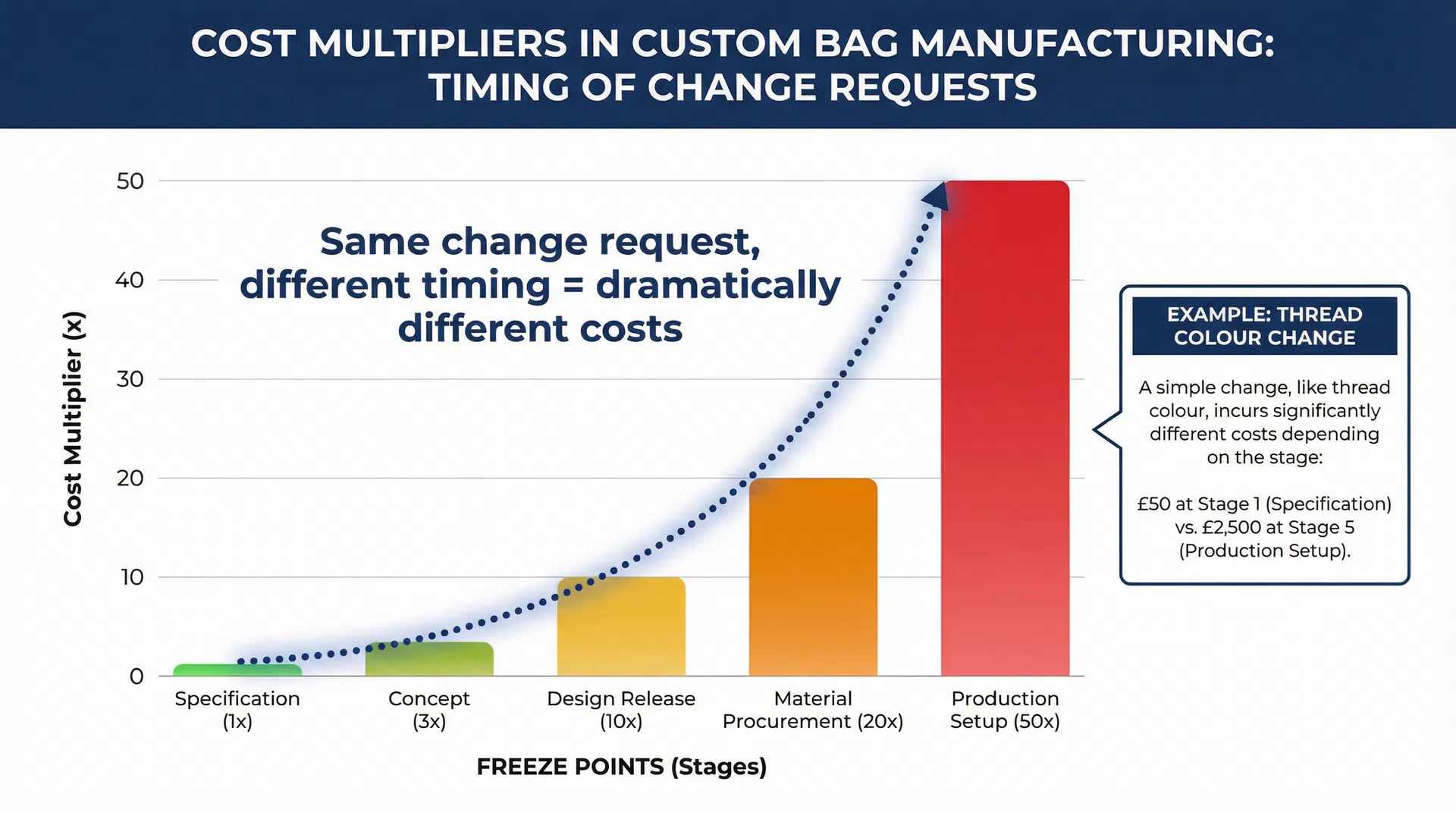
*Cost multiplier comparison across the five freeze points, demonstrating the exponential increase in change costs*
This understanding also explains why factories sometimes respond differently to seemingly similar change requests. A buyer might request a logo colour change on two different orders placed at similar times, and receive vastly different cost estimates. The difference is not factory inconsistency—it reflects the fact that one order has passed more freeze points than the other. The order that is further along in the production process will naturally incur higher change costs, even if the calendar dates of the original orders were similar.
The practical implication for procurement teams is that change management should be front-loaded rather than back-loaded. The time to identify potential changes is during the specification and concept stages, when the cost of modification is lowest. Waiting until "closer to the deadline" to finalise decisions is precisely the wrong approach, because each passing week typically moves the order through additional freeze points that increase the cost of any subsequent changes.
There is also a strategic dimension to this understanding. Buyers who recognise the freeze point cascade can negotiate more effectively with factories by requesting explicit information about which freeze points apply to their order and when each freeze point will be reached. This allows the buyer to align their internal approval processes with the factory's production timeline, ensuring that decisions are made before the relevant freeze points rather than after.
Some factories have begun providing more detailed timeline information that identifies these freeze points explicitly. This transparency benefits both parties—the buyer gains clarity about when decisions must be finalised, and the factory reduces the friction that arises from change requests made after critical freeze points. However, this level of transparency is not yet standard practice, and buyers should not assume that a factory's stated "deadline for changes" represents the full picture of their production timeline.
The cost multiplier effect also explains why experienced procurement professionals often build buffer time into their internal approval processes. They understand that the stated deadline is the absolute last point at which changes are possible, not the optimal point at which changes should be made. By completing internal approvals well before the factory's stated deadline, they ensure that any necessary changes can be made at earlier freeze points where the cost implications are more manageable.
For UK organisations sourcing custom promotional bags, this understanding is particularly relevant because the geographic distance between buyer and factory often extends communication timelines. A change request that seems urgent to the buyer may take several days to communicate, evaluate, and respond to. During that interval, the order may pass through additional freeze points, increasing the cost of the change. Buyers who account for this communication lag in their planning can avoid situations where a change that would have been inexpensive becomes costly simply due to timing.
The freeze point cascade also affects how buyers should evaluate factory quotations. A factory that provides a lower initial quote but has shorter windows between freeze points may ultimately cost more than a factory with a higher initial quote but longer windows for changes. The total cost of an order includes not just the quoted price but also the cost of any changes that become necessary during the production process. Buyers who evaluate factories solely on initial price may find themselves paying significantly more when changes are required.
This is not to suggest that all changes after early freeze points should be avoided. Some changes are necessary and worth the additional cost. The point is that buyers should make these decisions with full awareness of the cost implications rather than being surprised by them. A change that costs ten times more than expected is not inherently unreasonable—it simply reflects the reality of where the order sits in the production process. The buyer can then make an informed decision about whether the change is worth the cost, rather than feeling that the factory is being arbitrary or punitive.
The specification change window cascade represents one of the most significant gaps between buyer expectations and manufacturing reality in custom bag procurement. Closing this gap requires buyers to move beyond the simplified "deadline" model and understand the underlying structure of how factories commit resources over time. This understanding does not make changes free or easy, but it does make them predictable—and predictability is the foundation of effective procurement planning.