Why Your Approved Pre-Production Sample Was Made in a Different Environment Than Your Bulk Order
Pre-production samples are created in isolation from the production system that will manufacture your bulk order. Understanding why this matters helps organisations set realistic expectations for custom bag procurement.
· By BritBag Works
There is a structural reality in custom bag manufacturing that procurement teams rarely discuss openly, yet it shapes the outcome of nearly every bulk order. The sample that arrives for approval—the one that gets photographed, circulated to stakeholders, and ultimately signed off—was not made on the same production line, by the same workers, or under the same conditions as the thousands of units that will follow. This is not an oversight or a sign of supplier negligence. It is how manufacturing operates at scale, and misunderstanding it leads to disputes that could have been avoided with clearer expectations.
The sample room in a bag factory is a fundamentally different environment from the production floor. Sample makers are specialists. They are typically the most skilled craftspeople in the facility, capable of interpreting technical drawings, adjusting patterns on the fly, and hand-finishing details that would be impractical to replicate across thousands of units. When a sample maker receives a specification for a custom promotional tote bag, they approach it as a problem-solving exercise. They select the best available material from the warehouse, position the logo with careful measurement, and inspect every stitch before the piece leaves their workstation. The time investment is substantial—often sixty minutes or more for a single bag that would take ten to fifteen minutes on a production line.
This disparity in time allocation is not a luxury the factory chooses to extend to samples while withholding from bulk orders. It is a mathematical necessity. A production line processing five thousand bags in a week cannot afford to spend an hour on each unit. The economics do not permit it, and the delivery timeline would collapse. What the sample represents, therefore, is not what production will look like, but what is achievable under conditions that cannot be replicated at scale.
The practical implications of this distinction surface in predictable ways. Colour matching is one of the most common areas of divergence. A sample maker working on a single unit can adjust spray gun pressure, mixing ratios, and drying times until the Pantone reference is matched precisely. On a production line, those variables are calibrated once at the start of a run and monitored periodically, but micro-adjustments for each unit are not feasible. The result is colour variation within an acceptable tolerance band—typically plus or minus five percent—that may be invisible on a single bag but becomes noticeable when units are placed side by side.
Logo placement follows a similar pattern. The sample maker measures and positions the logo manually, often using templates and alignment guides that ensure millimetre-level precision. Production line operators work with jigs and fixtures designed for speed and consistency, but the tolerance for positioning is necessarily wider. A logo that sits perfectly centred on the sample may drift two to three millimetres on bulk units—within specification, but visibly different to a procurement team that has been staring at the approved sample for weeks.
Stitching density presents another area where sample and bulk production diverge. Sample makers often use slower machine speeds and tighter stitch settings to produce seams that look impeccable under close inspection. Production lines optimise for throughput, which means stitch density may be reduced slightly to maintain pace without compromising structural integrity. The bag functions identically, but the visual appearance of the seams differs.
The question that procurement teams should ask—but often do not—is whether the sample was produced in the factory's sample room or on the actual production line. The answer matters because it determines how representative the sample truly is. A pre-production sample made in the sample room demonstrates capability. A production sample made on the line demonstrates what the bulk order will actually look like. These are different things, and conflating them leads to misaligned expectations.
In practice, this is often where customization process decisions start to be misjudged. Buyers approve a sample that represents the factory's best work under ideal conditions, then express surprise when bulk units exhibit normal production variation. The factory has not changed materials, cut corners, or acted in bad faith. They have simply transitioned from a sample-making environment to a production environment, and the two operate under different constraints.
The structural separation between sample rooms and production lines exists for sound operational reasons. Sample makers need flexibility to experiment with new designs, test material combinations, and iterate quickly without disrupting production schedules. Production lines need standardisation, repeatability, and speed. Mixing these functions would compromise both. A sample maker pulled onto the production line loses the time needed for careful prototype development. A production line interrupted for sample work loses the rhythm that maintains quality and throughput.
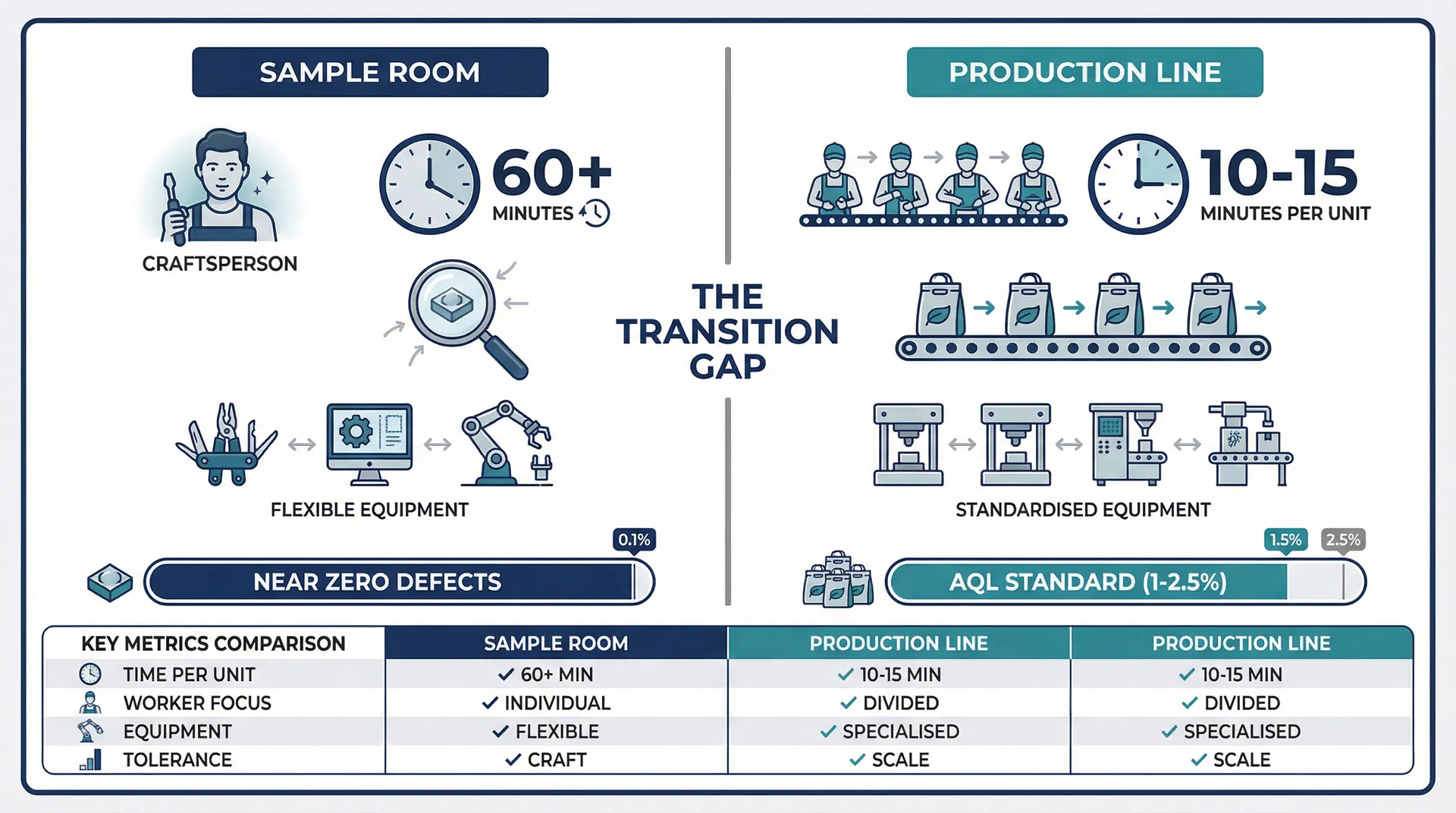
*Comparison of sample room environment versus production line environment showing differences in time per unit, worker specialisation, and quality tolerance*
Understanding this separation helps procurement teams ask better questions during the specification phase. Rather than simply approving a pre-production sample and assuming bulk will match, experienced buyers request a production sample—sometimes called a TOP sample (Top of Production)—made on the actual line after setup is complete but before full production begins. This additional checkpoint catches calibration issues, identifies equipment adjustments needed, and provides a more accurate preview of what the bulk order will deliver.
The cost of a production sample is typically higher than a pre-production sample because it requires the factory to set up the production line, run a short batch, and then pause for approval before continuing. Some buyers view this as an unnecessary expense, particularly for repeat orders or simple designs. The calculation changes when the cost of a production sample is weighed against the cost of receiving five thousand bags that do not match expectations. Rework, returns, and relationship damage far exceed the incremental investment in an additional approval step.
There is also a temporal dimension to the sample-production gap that buyers often overlook. The sample approved in January may have been made with materials sourced in December. By the time production begins in March, the factory may be drawing from a different material lot—same specification, same supplier, but a different batch with slight variations in texture, weight, or colour. These lot-to-lot variations are normal in textile manufacturing and fall within acceptable tolerances, but they contribute to the perception that bulk does not match the sample.
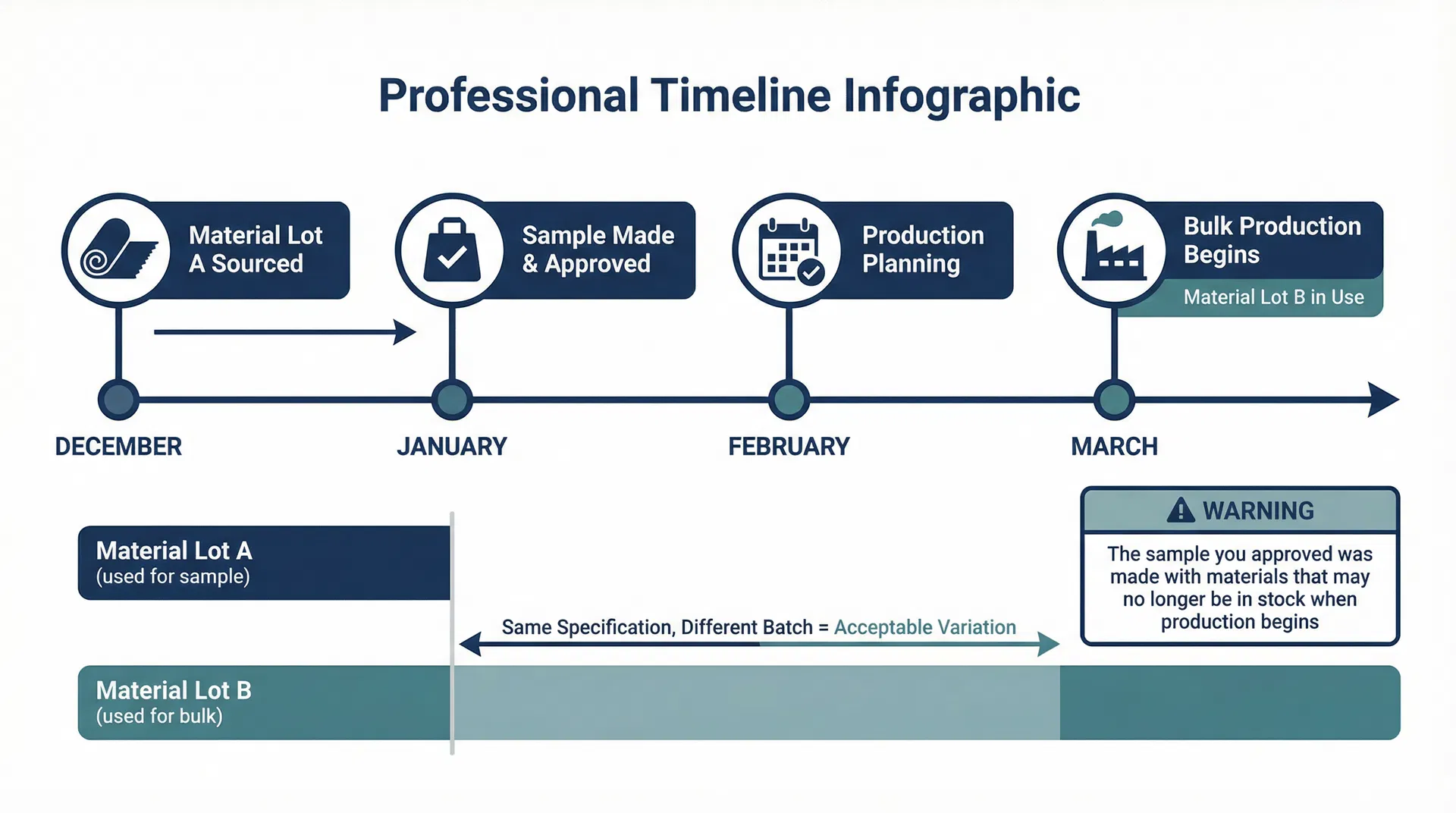
*Production timeline showing how material lot changes between sample approval and bulk production can introduce variations within specification*
The most effective approach to managing this gap is not to eliminate it—that is structurally impossible—but to acknowledge it explicitly in the specification and approval process. Tolerance ranges should be documented in writing, not assumed. Acceptable variation for logo position, colour, stitch density, and material weight should be agreed before production begins. When both parties understand that bulk will vary from the sample within defined limits, disputes become conversations about whether those limits were exceeded, rather than arguments about whether variation should exist at all.
For organisations navigating the [broader stages of custom bag production](/blog/custom-bag-customization-process-uk-guide), recognising the sample-production distinction is foundational. It shapes how specifications are written, how approvals are structured, and how quality is evaluated upon delivery. The sample is a reference point, not a promise. Treating it as such aligns expectations with manufacturing reality and reduces the friction that arises when bulk orders arrive looking slightly different from the prototype that everyone approved.
The underlying principle is that custom bag manufacturing involves a transition from craft to scale. The sample room operates in craft mode—individual attention, flexible problem-solving, time-intensive execution. The production line operates in scale mode—standardised processes, divided labour, throughput optimisation. Both are necessary, and both produce quality outcomes within their respective constraints. The misjudgment occurs when buyers expect scale to deliver craft-level consistency, or when factories fail to communicate that the transition involves inherent trade-offs.
Procurement teams that internalise this distinction approach bulk orders with more realistic expectations and more productive supplier relationships. They understand that the sample represents a capability demonstration, not a contractual guarantee of unit-by-unit replication. They build tolerance ranges into their specifications. They request production samples when the stakes justify the investment. And they evaluate bulk quality against agreed standards rather than against an idealised memory of the approved prototype.
The gap between sample and bulk is not a failure of the manufacturing process. It is a feature of how manufacturing operates at scale. Recognising this allows organisations to plan accordingly, communicate clearly with suppliers, and receive bulk orders that meet expectations—not because the expectations were lowered, but because they were properly calibrated from the start.
There is a further consideration that experienced procurement professionals factor into their planning: the human element of production line work. Sample makers typically work in quieter, less pressured environments where they can focus on a single piece for extended periods. Production line operators work in environments optimised for output, with shift targets, quality checkpoints, and the cognitive load of maintaining consistency across hundreds of units per day. Fatigue, attention drift, and the cumulative effect of repetitive tasks all influence the micro-variations that appear in bulk production. This is not a criticism of production workers—it is an acknowledgment of how human performance operates under different conditions.
The equipment used in sample rooms and production lines also differs in ways that affect outcomes. Sample makers often have access to adjustable, multi-purpose machines that can be configured for different bag styles and specifications. Production lines use specialised equipment optimised for specific operations—cutting, stitching, heat-sealing, printing—each calibrated for speed and repeatability rather than flexibility. A sample maker can pause mid-stitch to adjust tension or reposition fabric. A production line operator working within a timed workflow does not have that latitude.
For UK organisations sourcing custom promotional bags, this understanding has practical implications for how contracts are structured and how quality is assessed upon delivery. Rather than treating any deviation from the sample as a defect, experienced buyers establish tolerance bands that reflect manufacturing reality. A logo position tolerance of plus or minus three millimetres, a colour variation tolerance within Delta E 2.0, and a material weight tolerance of plus or minus five percent are examples of specifications that acknowledge the sample-production gap without compromising quality standards.
The conversation with suppliers also shifts when buyers demonstrate awareness of these dynamics. A procurement team that asks about sample room versus production line origin, requests production samples for high-stakes orders, and documents tolerance ranges in writing signals sophistication that suppliers respond to with greater transparency. The relationship becomes collaborative rather than adversarial, focused on meeting agreed standards rather than defending against unrealistic expectations.
Ultimately, the sample-production distinction is one of the foundational concepts in custom bag procurement that separates experienced buyers from those who learn through costly surprises. The sample is a demonstration of what the factory can achieve. The bulk order is a demonstration of what the factory can sustain. Both are valuable, and both serve different purposes in the procurement process. Aligning expectations with this reality is not about accepting lower quality—it is about understanding what quality means in the context of scaled manufacturing.