Why Reordering Last Year’s Corporate Gift Bag Almost Never Serves This Year’s Business Need
Procurement teams default to reordering last year’s successful gift bag because it is operationally efficient. But business objectives, recipient profiles, and brand positioning shift between cycles, making the same specification serve a fundamentally different strategic purpose.
· By BritBag Works
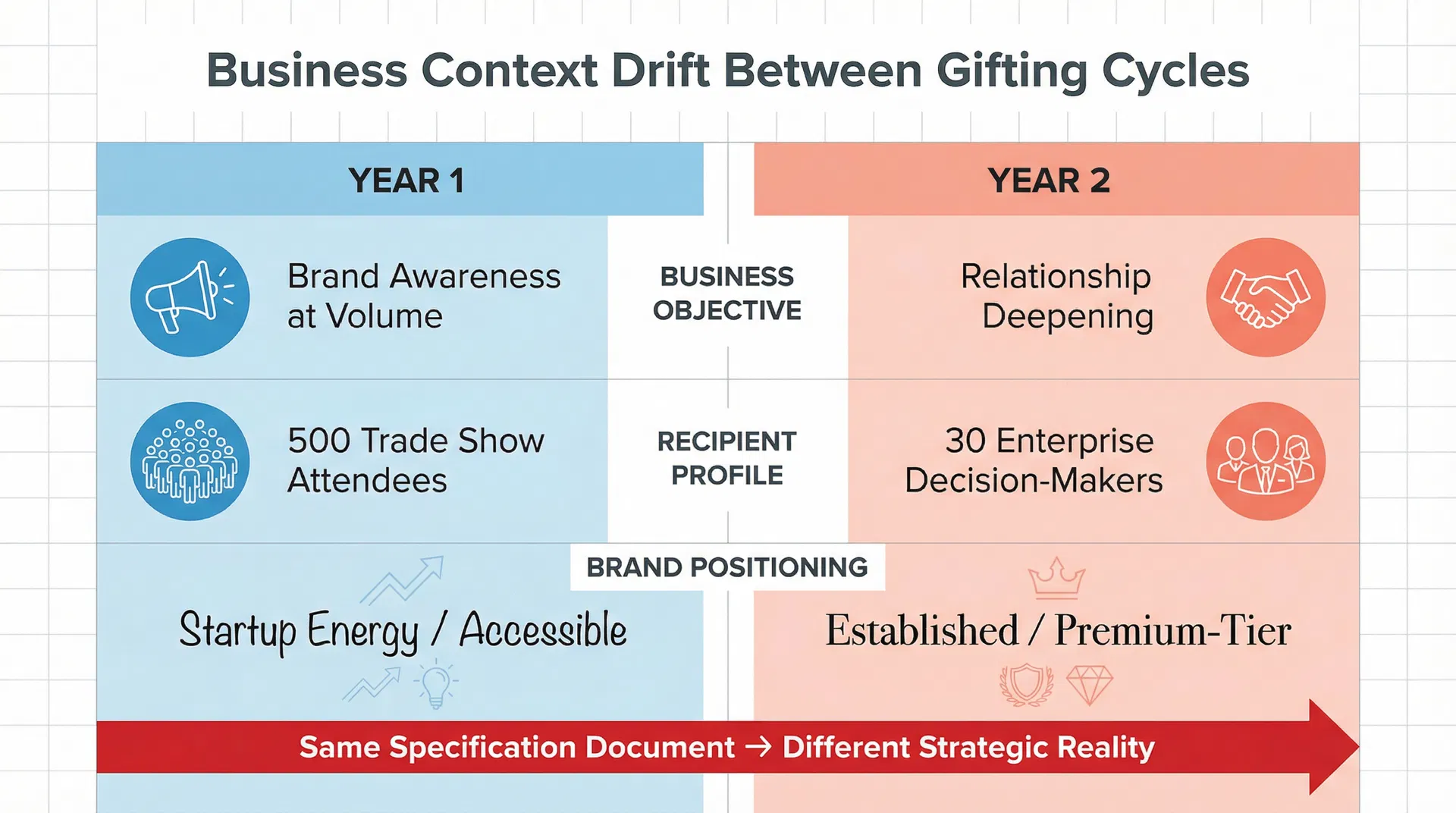 The recipient population is the second variable that shifts without anyone updating the specification. Even when the gifting occasion remains nominally the same — say, an annual client appreciation programme — the actual recipients change. New clients have been onboarded. Some existing clients have been promoted or have moved to different organisations. The seniority mix, industry distribution, and cultural composition of the recipient list may look substantially different from twelve months ago. A bag that resonated with a cohort of mid-level marketing managers may land very differently with a cohort that now includes C-suite executives from financial services firms, where the considerations explored in our overview of how custom bags move through the production process become particularly relevant to understanding what signals quality versus what signals generic volume purchasing.
There is also a subtler problem with the reorder instinct, which is the way “success” is evaluated. When a procurement team says last year’s bags “worked,” what they typically mean is that no one complained. The bags were delivered, distributed, and the gifting programme was completed without incident. But the absence of complaint is not the same as the presence of impact. No recipient is going to email the procurement team to say “your gift bag felt generic and I put it in the recycling bin on the way to my car.” The feedback loop for corporate gifts is almost entirely one-directional: you hear about failures, but silence is interpreted as success. This creates a survivorship bias that reinforces the reorder decision. The bags that generated no complaints are assumed to have generated positive impressions, when in reality they may have generated no impression at all.
From a production standpoint, the reorder assumption also carries a technical risk that procurement teams rarely account for. Placing the same specification twelve months later does not guarantee an identical product. Fabric dye lots shift between production runs. Thread suppliers may have changed. The printing equipment may have been recalibrated or replaced. Hardware components — zippers, clasps, magnetic closures — may now come from a different sub-supplier. The factory that produced last year’s batch may have subcontracted overflow to a secondary facility. All of these variables mean that a “reorder” is actually a new production run that happens to share a specification document with a previous one. The visual and tactile result can differ noticeably, particularly in colour consistency, fabric hand feel, and hardware finish — precisely the details that recipients notice even if they cannot articulate why this year’s bag feels different from last year’s.
The recipient population is the second variable that shifts without anyone updating the specification. Even when the gifting occasion remains nominally the same — say, an annual client appreciation programme — the actual recipients change. New clients have been onboarded. Some existing clients have been promoted or have moved to different organisations. The seniority mix, industry distribution, and cultural composition of the recipient list may look substantially different from twelve months ago. A bag that resonated with a cohort of mid-level marketing managers may land very differently with a cohort that now includes C-suite executives from financial services firms, where the considerations explored in our overview of how custom bags move through the production process become particularly relevant to understanding what signals quality versus what signals generic volume purchasing.
There is also a subtler problem with the reorder instinct, which is the way “success” is evaluated. When a procurement team says last year’s bags “worked,” what they typically mean is that no one complained. The bags were delivered, distributed, and the gifting programme was completed without incident. But the absence of complaint is not the same as the presence of impact. No recipient is going to email the procurement team to say “your gift bag felt generic and I put it in the recycling bin on the way to my car.” The feedback loop for corporate gifts is almost entirely one-directional: you hear about failures, but silence is interpreted as success. This creates a survivorship bias that reinforces the reorder decision. The bags that generated no complaints are assumed to have generated positive impressions, when in reality they may have generated no impression at all.
From a production standpoint, the reorder assumption also carries a technical risk that procurement teams rarely account for. Placing the same specification twelve months later does not guarantee an identical product. Fabric dye lots shift between production runs. Thread suppliers may have changed. The printing equipment may have been recalibrated or replaced. Hardware components — zippers, clasps, magnetic closures — may now come from a different sub-supplier. The factory that produced last year’s batch may have subcontracted overflow to a secondary facility. All of these variables mean that a “reorder” is actually a new production run that happens to share a specification document with a previous one. The visual and tactile result can differ noticeably, particularly in colour consistency, fabric hand feel, and hardware finish — precisely the details that recipients notice even if they cannot articulate why this year’s bag feels different from last year’s.
 The brand positioning dimension is perhaps the most consequential and the least visible to procurement. Companies evolve their market positioning continuously. A business that was projecting startup energy and accessibility eighteen months ago may now be positioning itself as an established, premium-tier provider. The visual language of the brand — colour palette, typography, material choices — has likely been updated across marketing collateral, website, and sales materials. Yet the corporate gift bag, which is often the only physical object a client or employee receives from the company, remains frozen in last year’s brand expression. It becomes an artefact of a previous identity, distributed alongside current messaging. The dissonance is subtle but real, and it is particularly noticeable to recipients who interact with the brand across multiple touchpoints.
The practical consequence of all this is not that reordering is always wrong. There are circumstances where consistency is strategically appropriate — a long-running employee onboarding programme, for instance, where the bag is part of a standardised welcome kit and brand continuity matters more than novelty. But these are specific, deliberate decisions, not defaults. The problem arises when reordering becomes the default because it is operationally convenient, and the strategic assessment that should precede every gifting decision is skipped entirely.
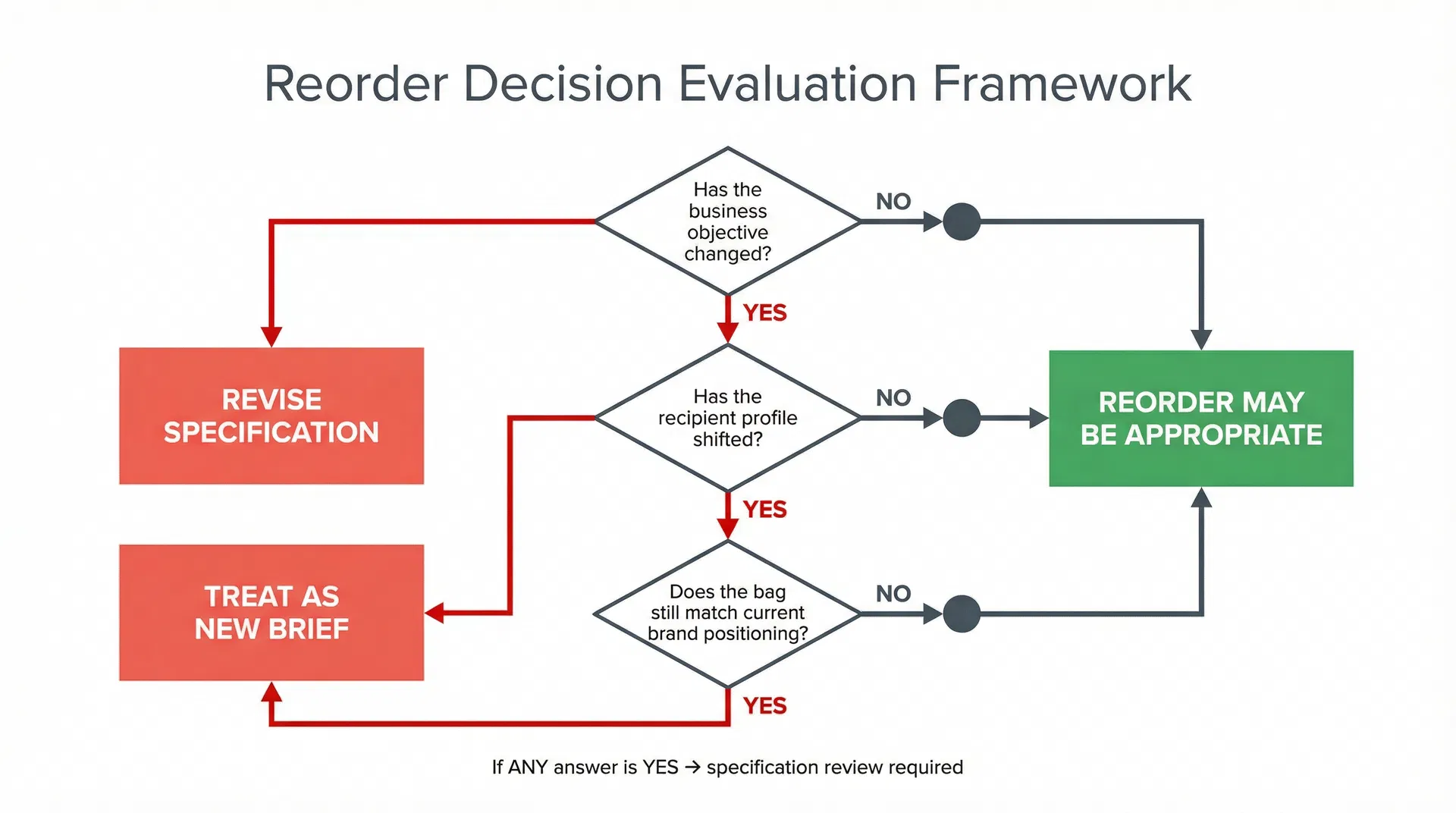
What tends to work better is treating each gifting cycle as a fresh brief, even when the budget and timeline are similar to the previous year. This does not mean starting from scratch with a new supplier every time. It means asking three questions before any specification is confirmed: has the business objective for this gifting programme changed? Has the recipient profile shifted? And does the current bag specification still align with where the brand is today? If the answer to any of these is yes — and in most growing businesses, at least one will be — then the specification needs to be revisited, even if the supplier and the general product category remain the same.
There is one more dimension worth noting, because it catches even experienced procurement teams off guard. The competitive landscape for corporate gifting shifts year over year. The clients and partners receiving your bags are also receiving bags from your competitors, from their other vendors, from industry associations and event organisers. What felt distinctive twelve months ago may now feel generic, not because your bag has changed but because everyone else has caught up. The cotton tote with a minimalist logo that stood out at last year’s conference is now the baseline expectation. Reordering it means matching the floor rather than raising it.
The cost of reassessment is minimal. It typically adds one or two meetings to the procurement timeline and may result in modest specification adjustments rather than a complete redesign. A shift from screen printing to debossed leather patches, or from a standard cotton to a heavier brushed canvas, can reposition the same general product category without requiring a new supplier qualification process. The cost of not doing it is harder to quantify but no less real: a gifting programme that technically executes on time and on budget but fails to achieve any strategic purpose, because it was designed for a business that no longer exists in the form it did twelve months ago. The reorder button is the easiest click in procurement. It is also, more often than not, the one that deserves the most scrutiny before it becomes the default response to a question that was never properly asked: what does this business actually need its corporate gift bags to accomplish right now, for this specific audience, at this particular stage of its growth?
The brand positioning dimension is perhaps the most consequential and the least visible to procurement. Companies evolve their market positioning continuously. A business that was projecting startup energy and accessibility eighteen months ago may now be positioning itself as an established, premium-tier provider. The visual language of the brand — colour palette, typography, material choices — has likely been updated across marketing collateral, website, and sales materials. Yet the corporate gift bag, which is often the only physical object a client or employee receives from the company, remains frozen in last year’s brand expression. It becomes an artefact of a previous identity, distributed alongside current messaging. The dissonance is subtle but real, and it is particularly noticeable to recipients who interact with the brand across multiple touchpoints.
The practical consequence of all this is not that reordering is always wrong. There are circumstances where consistency is strategically appropriate — a long-running employee onboarding programme, for instance, where the bag is part of a standardised welcome kit and brand continuity matters more than novelty. But these are specific, deliberate decisions, not defaults. The problem arises when reordering becomes the default because it is operationally convenient, and the strategic assessment that should precede every gifting decision is skipped entirely.
What tends to work better is treating each gifting cycle as a fresh brief, even when the budget and timeline are similar to the previous year. This does not mean starting from scratch with a new supplier every time. It means asking three questions before any specification is confirmed: has the business objective for this gifting programme changed? Has the recipient profile shifted? And does the current bag specification still align with where the brand is today? If the answer to any of these is yes — and in most growing businesses, at least one will be — then the specification needs to be revisited, even if the supplier and the general product category remain the same.
There is one more dimension worth noting, because it catches even experienced procurement teams off guard. The competitive landscape for corporate gifting shifts year over year. The clients and partners receiving your bags are also receiving bags from your competitors, from their other vendors, from industry associations and event organisers. What felt distinctive twelve months ago may now feel generic, not because your bag has changed but because everyone else has caught up. The cotton tote with a minimalist logo that stood out at last year’s conference is now the baseline expectation. Reordering it means matching the floor rather than raising it.
The cost of reassessment is minimal. It typically adds one or two meetings to the procurement timeline and may result in modest specification adjustments rather than a complete redesign. A shift from screen printing to debossed leather patches, or from a standard cotton to a heavier brushed canvas, can reposition the same general product category without requiring a new supplier qualification process. The cost of not doing it is harder to quantify but no less real: a gifting programme that technically executes on time and on budget but fails to achieve any strategic purpose, because it was designed for a business that no longer exists in the form it did twelve months ago. The reorder button is the easiest click in procurement. It is also, more often than not, the one that deserves the most scrutiny before it becomes the default response to a question that was never properly asked: what does this business actually need its corporate gift bags to accomplish right now, for this specific audience, at this particular stage of its growth?