Why the Custom Branded Bag That Wins Over Your Client Falls Flat as an Employee Gift
A custom bag designed to impress clients uses prominent branding, formal materials, and presentation packaging — design choices that employees interpret as corporate merchandise rather than personal recognition. The same specification that signals professionalism to an external audience signals indifference to an internal one.
· By BritBag Works
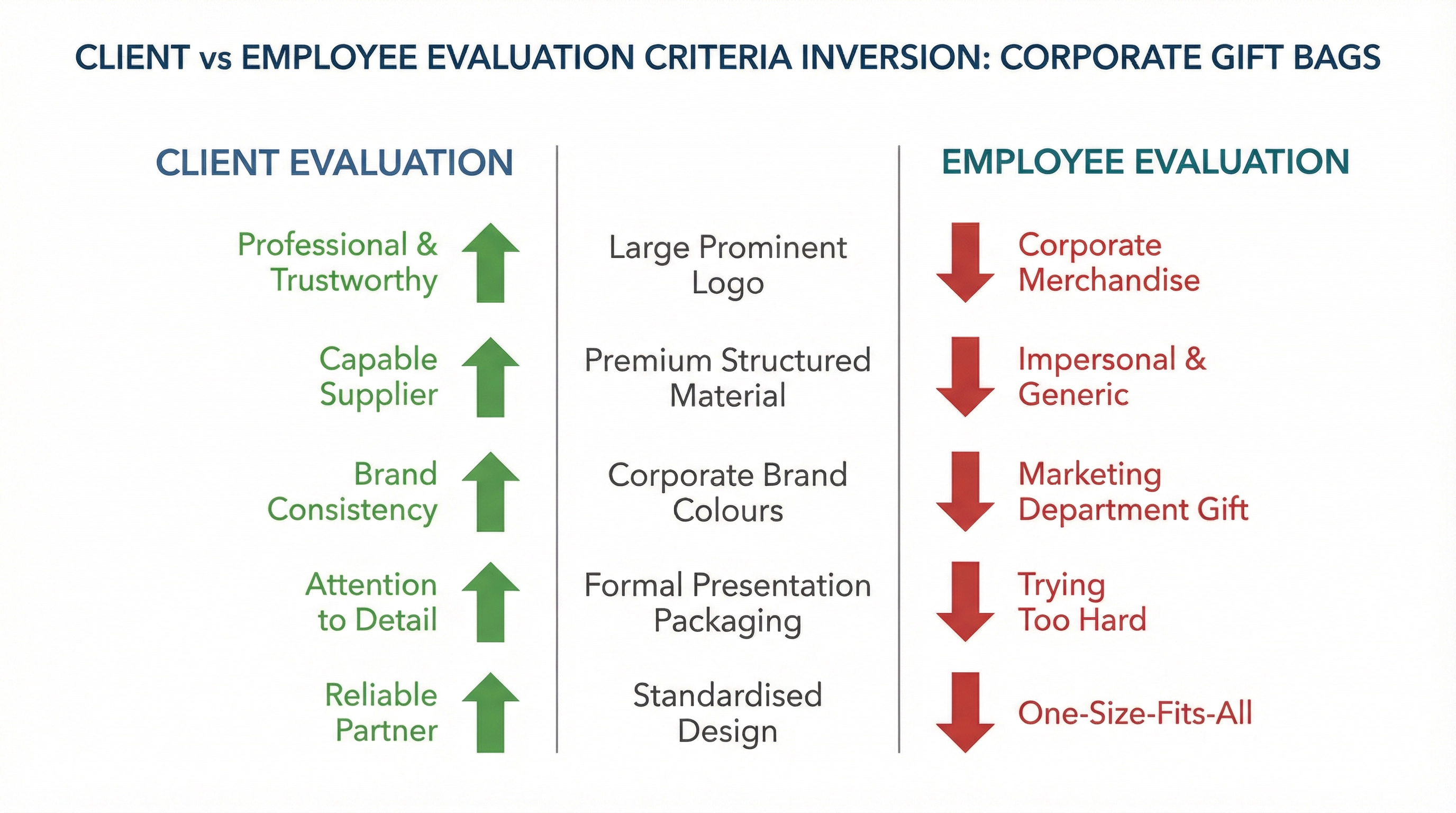 What employees respond to in a corporate gift bag is almost the inverse of what clients respond to. Employees value subtlety in branding — a small debossed logo on a leather tag, a tone-on-tone print on the interior lining, a woven label tucked inside the pocket. They value material choices that suggest someone thought about their actual life — a bag sized for a laptop and a lunch container, a water-resistant lining for a cycling commuter, a structured base that stands upright under a desk. They value finishing details that feel considered rather than corporate — a magnetic closure instead of a zip, a natural cotton handle instead of a nylon webbing strap, an earth-toned palette instead of the company’s brand blue.
The production implications of these differences are not trivial. A bag designed for employee appreciation typically requires different artwork placement, different material selection, and often different construction methods than a client-facing bag. The logo treatment alone can change the print method — moving from a large screen-printed front panel to a small debossed leather patch changes the tooling, the production sequence, and the unit cost. The material shift from a structured polyester to a washed canvas or a recycled cotton changes the cutting layout, the sewing tension, and the finishing process. These are not cosmetic adjustments; they are fundamentally different production setups.
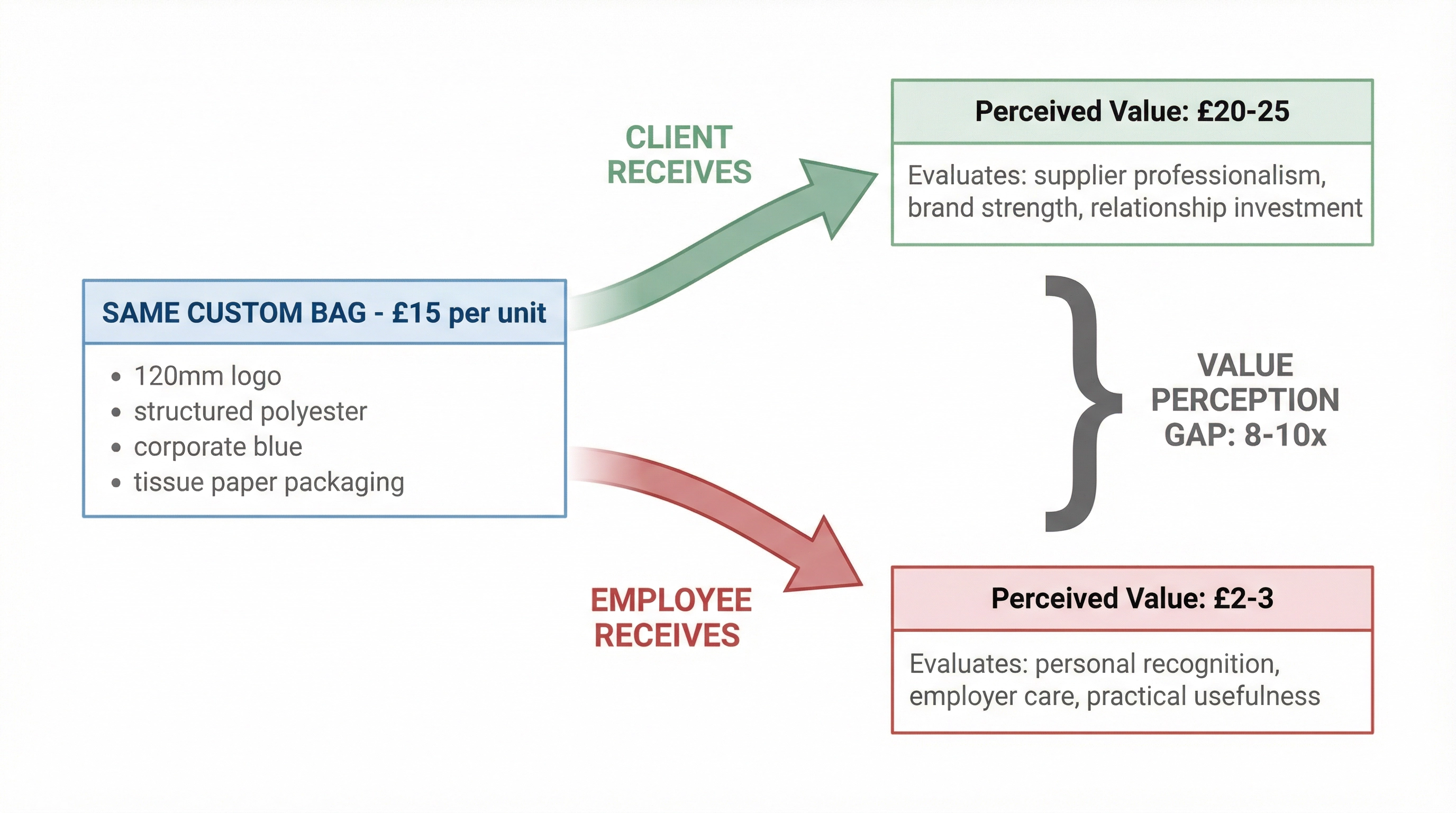
The consequence of ignoring this distinction plays out in ways that procurement teams rarely see directly. An employee who receives a repurposed client gift bag does not complain. They do not send it back. They do not file a formal objection with HR. They simply do not use it. The bag goes into a drawer, or it gets left in the office kitchen, or it becomes a grocery bag — which is precisely the fate that the procurement team was trying to avoid when they invested in a “premium” gift. The per-unit cost might have been twelve or fifteen pounds, but the perceived value to the employee is closer to two or three pounds, because the bag communicates “we had extras” rather than “we thought about you.”
There is a secondary effect that compounds this problem. When employees see the same bag being distributed at a client event and then handed out internally at a team meeting, the gift loses whatever residual appreciation it might have carried. The employee now understands that they received the same item as an external contact — someone the company is trying to impress. The implicit message shifts from recognition to logistics: the company had surplus inventory and needed somewhere to allocate it. Even when this is not the actual procurement rationale, the optics are difficult to overcome once an employee has made that connection.
What employees respond to in a corporate gift bag is almost the inverse of what clients respond to. Employees value subtlety in branding — a small debossed logo on a leather tag, a tone-on-tone print on the interior lining, a woven label tucked inside the pocket. They value material choices that suggest someone thought about their actual life — a bag sized for a laptop and a lunch container, a water-resistant lining for a cycling commuter, a structured base that stands upright under a desk. They value finishing details that feel considered rather than corporate — a magnetic closure instead of a zip, a natural cotton handle instead of a nylon webbing strap, an earth-toned palette instead of the company’s brand blue.
The production implications of these differences are not trivial. A bag designed for employee appreciation typically requires different artwork placement, different material selection, and often different construction methods than a client-facing bag. The logo treatment alone can change the print method — moving from a large screen-printed front panel to a small debossed leather patch changes the tooling, the production sequence, and the unit cost. The material shift from a structured polyester to a washed canvas or a recycled cotton changes the cutting layout, the sewing tension, and the finishing process. These are not cosmetic adjustments; they are fundamentally different production setups.
The consequence of ignoring this distinction plays out in ways that procurement teams rarely see directly. An employee who receives a repurposed client gift bag does not complain. They do not send it back. They do not file a formal objection with HR. They simply do not use it. The bag goes into a drawer, or it gets left in the office kitchen, or it becomes a grocery bag — which is precisely the fate that the procurement team was trying to avoid when they invested in a “premium” gift. The per-unit cost might have been twelve or fifteen pounds, but the perceived value to the employee is closer to two or three pounds, because the bag communicates “we had extras” rather than “we thought about you.”
There is a secondary effect that compounds this problem. When employees see the same bag being distributed at a client event and then handed out internally at a team meeting, the gift loses whatever residual appreciation it might have carried. The employee now understands that they received the same item as an external contact — someone the company is trying to impress. The implicit message shifts from recognition to logistics: the company had surplus inventory and needed somewhere to allocate it. Even when this is not the actual procurement rationale, the optics are difficult to overcome once an employee has made that connection.
 Understanding how these decisions connect to the broader process of producing custom bags for different purposes helps clarify why the specification stage is where the audience distinction needs to be established. Once a production brief is locked and sampling begins, the design language is fixed. Changing the branding approach, material selection, or construction method after sample approval means restarting the development cycle — new samples, new approvals, new timelines. The cost of running two parallel specifications from the beginning is a fraction of the cost of retrofitting a client-optimised bag for internal use after production has started.
The pattern is consistent across the orders we process. Companies that treat employee gift bags as a separate product category — with their own brief, their own sample approval, and their own design priorities — report significantly higher usage rates and more positive internal feedback. Companies that add employee units to a client order as an afterthought consistently find that the bags accumulate in storage rooms and eventually get donated or discarded. The production cost difference between these two approaches is typically fifteen to twenty-five percent. The difference in gift effectiveness is closer to three hundred percent.
What makes this particularly difficult for procurement teams to recognise is that the quality metrics they use to evaluate a bag — material weight, stitch count, print resolution, hardware grade — are identical for both audiences. A bag can score perfectly on every objective quality measure and still fail completely as an employee gift because the design intent was wrong. Quality and appropriateness are not the same dimension, and the specification process for corporate gift bags needs to account for both. The factory can produce exactly what the brief requests. The question is whether the brief was written for the right audience.
The practical resolution is not complicated, but it does require procurement teams to treat internal and external gift bags as separate product categories from the very first conversation with their supplier. The brief should specify the audience before it specifies the material. The sample approval process should include someone from the people or HR team, not just the marketing department. And the production timeline should account for two parallel development tracks rather than one specification with a volume add-on. The additional cost is real but modest. The difference in how the gift is received — and whether it achieves its intended purpose — is substantial enough to justify the investment every time.
Understanding how these decisions connect to the broader process of producing custom bags for different purposes helps clarify why the specification stage is where the audience distinction needs to be established. Once a production brief is locked and sampling begins, the design language is fixed. Changing the branding approach, material selection, or construction method after sample approval means restarting the development cycle — new samples, new approvals, new timelines. The cost of running two parallel specifications from the beginning is a fraction of the cost of retrofitting a client-optimised bag for internal use after production has started.
The pattern is consistent across the orders we process. Companies that treat employee gift bags as a separate product category — with their own brief, their own sample approval, and their own design priorities — report significantly higher usage rates and more positive internal feedback. Companies that add employee units to a client order as an afterthought consistently find that the bags accumulate in storage rooms and eventually get donated or discarded. The production cost difference between these two approaches is typically fifteen to twenty-five percent. The difference in gift effectiveness is closer to three hundred percent.
What makes this particularly difficult for procurement teams to recognise is that the quality metrics they use to evaluate a bag — material weight, stitch count, print resolution, hardware grade — are identical for both audiences. A bag can score perfectly on every objective quality measure and still fail completely as an employee gift because the design intent was wrong. Quality and appropriateness are not the same dimension, and the specification process for corporate gift bags needs to account for both. The factory can produce exactly what the brief requests. The question is whether the brief was written for the right audience.
The practical resolution is not complicated, but it does require procurement teams to treat internal and external gift bags as separate product categories from the very first conversation with their supplier. The brief should specify the audience before it specifies the material. The sample approval process should include someone from the people or HR team, not just the marketing department. And the production timeline should account for two parallel development tracks rather than one specification with a volume add-on. The additional cost is real but modest. The difference in how the gift is received — and whether it achieves its intended purpose — is substantial enough to justify the investment every time.