Why the Number on Your Corporate Gift Bag Brief Is Choosing the Bag Type for You
Order quantity is treated as a logistics detail on corporate gift briefs, but it is the single variable that most determines which bag types are actually available. Different volume bands unlock different materials, hardware, production methods, and quality tiers — and procurement teams rarely discover that their preferred bag type was never viable at the quantity they specified.
· By BritBag Works
There is a number on every corporate gift bag brief that procurement teams treat as a logistics detail, and it is quietly making the most consequential decision of the entire programme. That number is the order quantity. Whether the brief calls for 150 units for a board-level client dinner, 800 for a regional sales conference, or 3,000 for a national employee recognition programme, the quantity is typically decided based on headcount, budget allocation, and distribution logistics. What it is almost never evaluated against is the manufacturing reality that different quantity bands unlock entirely different categories of bag types — and that the number written on the brief may have already eliminated the bag type that would have best served the business objective.
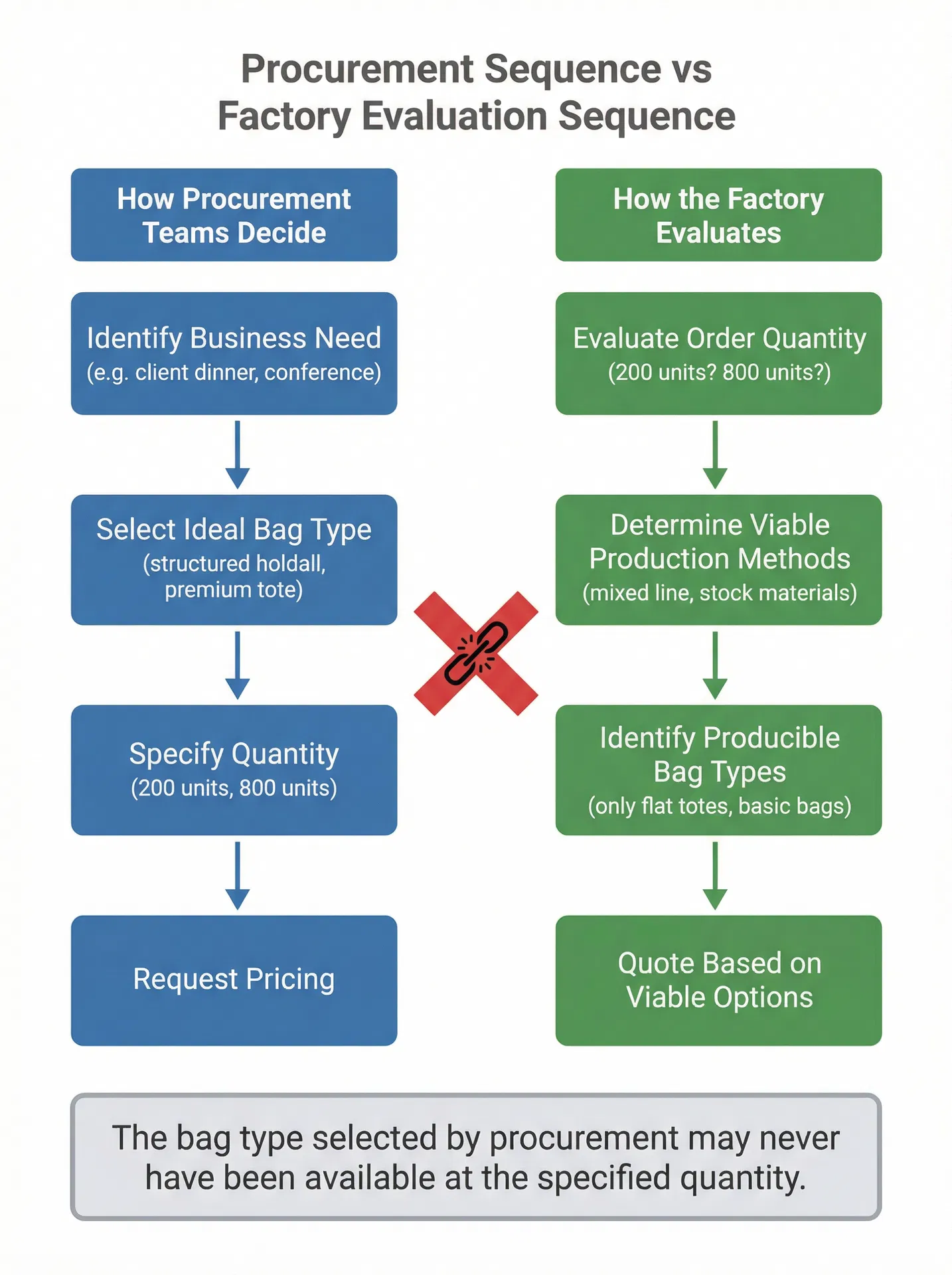
The misunderstanding is structural. Procurement teams approach the decision in a sequence that feels logical: identify the business need, select the ideal bag type, specify the quantity required, then request pricing. The factory receives the same brief and processes it in the opposite direction: evaluate the quantity first, determine which production methods and materials are viable at that volume, identify which bag types can actually be manufactured to specification, and then quote accordingly. These two sequences produce fundamentally different outcomes, and the procurement team rarely discovers that the bag type they selected was never truly available at the quantity they specified.
The mechanics of this constraint begin at the material sourcing stage. Custom bag manufacturing requires specific fabrics, hardware, linings, and printing substrates, each of which has its own minimum order threshold from the material supplier. A premium waxed canvas, for instance, may require a minimum fabric order of 300 metres — enough for approximately 1,200 bags of a standard tote size. If the corporate gift programme requires only 200 units, the factory cannot economically source that material. The options become limited to whatever compatible fabrics are already in stock, which typically means standard cotton canvas, basic non-woven polypropylene, or lightweight polyester — materials that support a narrow range of bag constructions. The procurement team specified a structured waxed canvas holdall. The factory can only offer a flat cotton tote at that quantity. The bag type changed not because of a design decision but because of a material sourcing threshold that was never communicated.
Hardware presents an identical constraint that operates at even more restrictive quantity thresholds. Custom zip pulls, branded magnetic closures, metal feet, and reinforced D-ring attachments all require tooling — the creation of moulds or dies specific to the design. Tooling costs are fixed regardless of quantity: a custom zip pull mould might cost eight hundred to twelve hundred pounds. At 3,000 units, that tooling cost distributes to roughly thirty to forty pence per bag — negligible. At 200 units, the same tooling adds four to six pounds per unit, which can represent a twenty to thirty per cent increase in the total bag cost. The factory knows this arithmetic before the first sample is cut. When the quantity falls below the threshold where custom hardware is economically viable, the factory defaults to stock hardware — standard zip pulls, generic magnetic snaps, off-the-shelf buckles. These stock components dictate which bag constructions are possible. A structured messenger bag that requires a specific closure mechanism becomes a simple flap-over bag with a generic snap. The bag type shifts, and the procurement team sees it as a design recommendation rather than a quantity-driven constraint.
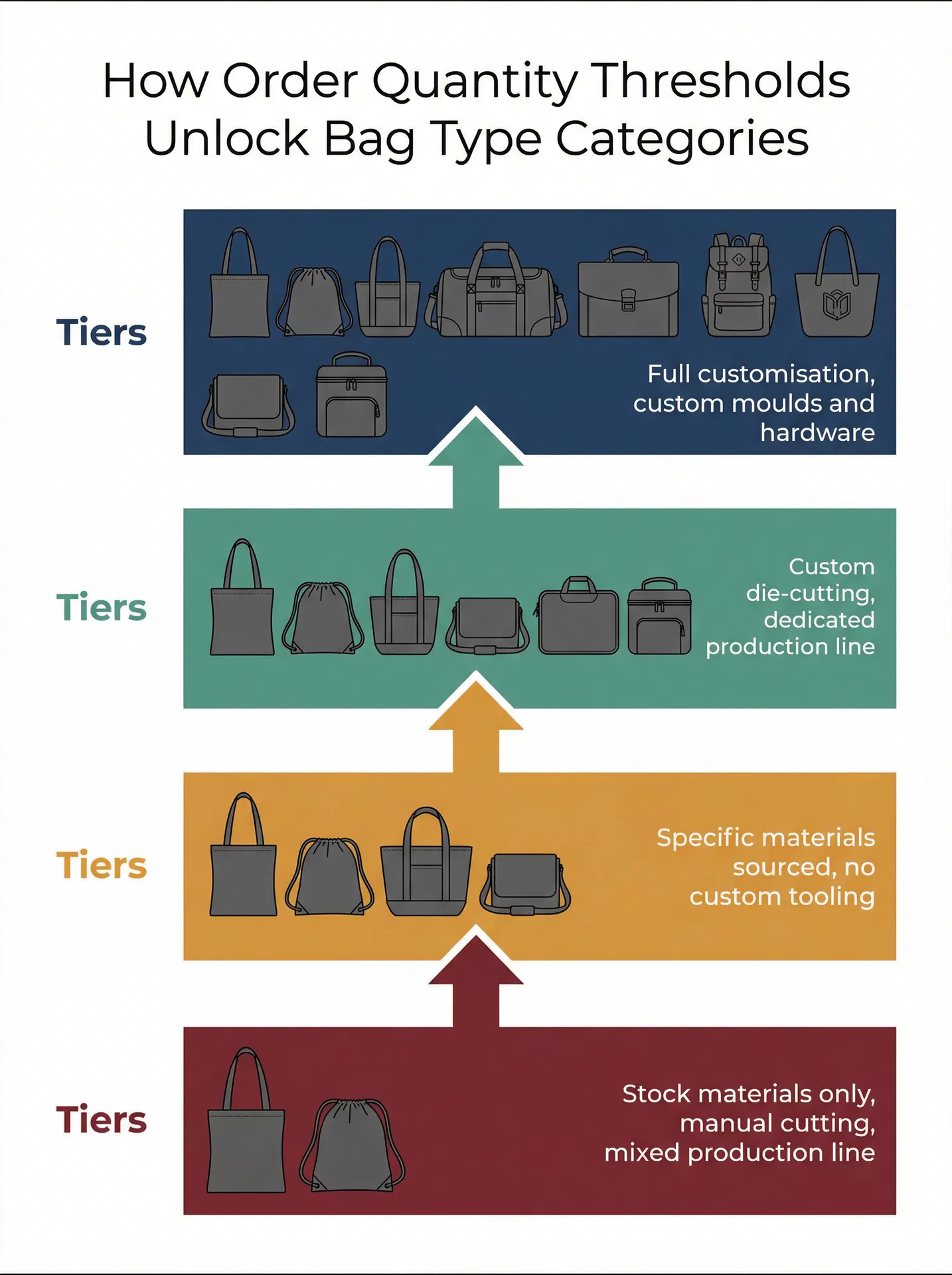
The production line itself introduces another layer of quantity-dependent type selection that is rarely visible to buyers. Bag manufacturing involves sequential operations — cutting, stitching, assembly, hardware attachment, printing, quality inspection — each performed by different operators or stations. For orders above approximately 2,000 units, the factory can dedicate a production line to the order, with each station calibrated specifically for that bag's construction. This dedicated line produces consistent quality because every operator performs the same task repeatedly, building muscle memory and reducing error rates. Below 2,000 units, the order is typically placed on a mixed production line, where operators switch between different bag constructions throughout the day. The changeover between bag types introduces variability — different seam allowances, different assembly sequences, different quality checkpoints. Structured bags with multiple panels, internal pockets, and reinforced bases are particularly sensitive to this variability because they require precise alignment at each assembly stage. On a mixed line, the reject rate for complex constructions can be two to three times higher than on a dedicated line. The factory factors this into the quotation, and the per-unit cost for a structured bag at 500 units may approach the cost of a premium bag at 2,000 units — not because the materials are more expensive, but because the production inefficiency at lower volumes makes complex constructions economically irrational.
Die-cutting is another threshold that silently reshapes the available bag types. For orders above approximately 1,000 units, the factory invests in custom cutting dies — steel templates that cut fabric panels to precise, repeatable dimensions. Die-cut panels ensure that every bag in the production run has identical proportions, which is essential for structured bags where panel alignment determines the final shape. Below the die-cutting threshold, panels are cut manually or with generic templates, introducing dimensional variation of two to four millimetres per panel. On a flat tote bag, this variation is invisible — the bag is unstructured, and slight dimensional differences disappear when the bag is filled. On a structured laptop sleeve, a briefcase-style bag, or a rigid-sided cooler bag, the same variation produces visible misalignment at seams, uneven bases, and panels that do not sit flush. The factory knows that producing structured bags without die-cutting will result in quality complaints, so they steer the order toward unstructured formats that tolerate the dimensional variation inherent in manual cutting. The procurement team receives a recommendation for a tote bag and interprets it as a design suggestion. It was a manufacturing constraint.
The quality inspection dimension of this problem is particularly relevant for corporate gift programmes, where every unit will be scrutinised by the recipient. Large orders follow standardised inspection protocols — typically AQL (Acceptable Quality Level) sampling at defined ratios, with documented inspection criteria at each production stage. The inspection infrastructure is justified by the volume: training inspectors on the specific quality standards for a 5,000-unit order is a worthwhile investment. For orders below 500 units, the factory cannot justify dedicated inspection resources. Quality control is typically performed by the production technicians themselves, or by a general inspector covering multiple orders simultaneously. The result is that defect detection rates are lower for small orders, and the types of defects that pass through — inconsistent stitching tension, minor colour variation between units, hardware alignment issues — are precisely the defects that are most noticeable on structured, premium bag types. A flat tote bag with slightly inconsistent stitching is rarely noticed. A structured leather-trimmed portfolio bag with the same inconsistency looks defective. The factory understands this risk profile and, when the quantity does not support dedicated inspection, recommends bag types that are more forgiving of the quality variation that small-batch production inherently introduces.
There is a compounding effect that procurement teams almost never anticipate: the quantity threshold does not just constrain the initial bag type selection — it constrains the correction options when problems arise during production. If a 5,000-unit order encounters a fabric defect at the 2,000-unit mark, the factory can source replacement material from the same dye lot, recalibrate the production line, and continue with minimal disruption. If a 300-unit order encounters the same defect at the 150-unit mark, the remaining fabric may be insufficient to complete the order, the replacement material may come from a different dye lot with perceptible colour variation, and the mixed production line may have already moved on to another order, requiring a scheduling renegotiation to resume production. The practical consequence is that small orders have less resilience to production disruptions, and the bag types that are most vulnerable to disruption — those requiring specific materials, precise construction, and consistent finishing — are exactly the types that should not be produced at volumes below their viability threshold.
The pattern that emerges across hundreds of corporate gift programmes is remarkably consistent. A procurement team specifies a quantity based on recipient headcount, selects a bag type based on the business occasion, and sends the brief to the factory. The factory evaluates the quantity against its production thresholds and determines that the specified bag type is not viable at that volume — the materials cannot be sourced economically, the hardware requires tooling that the quantity cannot amortise, the production line cannot be dedicated, and the quality inspection cannot be resourced. Rather than explaining this cascade of constraints, the factory presents alternative bag types that are producible at the specified quantity, framing the recommendation as a design improvement or a cost-saving measure. The procurement team accepts the recommendation, believing they are making a pragmatic choice. In reality, the choice was made by the quantity figure on the brief, and the bag type that would have best served the business purpose was never truly on the table.
Understanding which bag types align with different corporate gifting objectives requires recognising that the quantity decision is not independent of the type decision. They are interdependent variables, and the sequence in which they are evaluated determines the outcome. When the quantity is set first and treated as fixed, the available bag types narrow to whatever can be manufactured viably at that volume. When the bag type is selected first for strategic fit, the quantity may need to adjust — either upward to reach the production threshold for that type, or the programme may need to be restructured to accommodate the manufacturing reality. The procurement teams that consistently achieve the best outcomes are those that treat the quantity specification as a design variable, not a logistics given — and that understand that the number on the brief is not just determining how many bags they will receive, but which bags they are able to receive.