Why a Single Corporate Gift Bag Specification Fails When Your Programme Spans Multiple Markets
A specification written for UK distribution enters fundamentally different regulatory, cultural, and environmental contexts when applied across EU, US, and Asia-Pacific markets. Labelling requirements, chemical compliance thresholds, climate-driven material performance, and cultural expectations around finish quality all diverge in ways that a single document cannot reconcile without explicit regional adaptation.
· By BritBag Works
When a corporate gifting programme expands beyond a single market, the procurement team's instinct is to standardise. One specification document, one approved supplier, one bag design distributed to offices and clients across multiple countries. The logic is compelling: standardisation reduces procurement complexity, ensures brand consistency, and allows the team to negotiate volume pricing. In practice, this is where decisions about which types of corporate gifts work best for different business contexts begin to fracture — not because the specification is poorly written, but because it was written for one regulatory and cultural environment and then applied to several others that operate under fundamentally different rules.
The specification document itself is the source of the problem, though not in the way most procurement teams expect. A well-crafted specification for a custom branded cotton tote bag destined for UK distribution might read: 280gsm organic cotton, GOTS certified, screen-printed logo in two Pantone colours, reinforced stitching on handles, unbleached natural finish. Every detail is precise, every material choice deliberate. The document reflects UK textile labelling requirements, UK cultural expectations around sustainability messaging, and UK climate conditions that make cotton a sensible year-round material. The moment that same specification is forwarded to offices in Dubai, Singapore, Frankfurt, and New York, it enters four distinct regulatory environments, four different climate zones, and four sets of cultural assumptions about what a corporate gift bag should look and feel like.
The regulatory divergence is the most concrete and the least forgivable when it goes wrong. The European Union's Textile Labelling Regulation requires that every textile product sold or distributed within the EU carry a label stating the precise fibre composition percentage of every component — not rounded, not approximate, but exact. The UK, post-Brexit, maintains its own version through the Textile Products (Labelling and Fibre Composition) Regulations 2012, which are similar but not identical. A bag labelled correctly for UK distribution may not meet EU requirements if the fibre composition label omits a minor component that falls below the UK's de minimis threshold but exceeds the EU's. The United States, operating under the Textile Fiber Products Identification Act, allows the omission of non-major fibres below five per cent, labelled simply as "other fibers" — a convention that would be non-compliant in the EU. Canada requires bilingual labelling in English and French with symmetrical font sizing. China mandates all labels in Chinese. A single specification document cannot satisfy all of these requirements simultaneously without explicit regional label variants, and most procurement teams do not think to specify label variants because they are focused on the bag itself, not the regulatory infrastructure surrounding it.
The chemical compliance layer adds another dimension that a single specification cannot address. The EU's REACH regulation restricts the use of certain chemical substances in textile products, including specific azo dyes and heavy metal concentrations. The UK has adopted its own version of REACH (UK REACH), which currently mirrors the EU version but is diverging as the UK develops its own restricted substances list. A bag that passes UK REACH testing may not pass EU REACH testing twelve months from now if the EU adds a substance to its restricted list that the UK has not yet adopted. Meanwhile, California's Proposition 65 requires warning labels on products containing chemicals known to cause cancer or reproductive harm — a threshold that is significantly lower than either EU or UK REACH limits. A cotton bag that is perfectly compliant in London may require an additional warning label in Los Angeles, and the absence of that label creates legal liability for the distributing company.
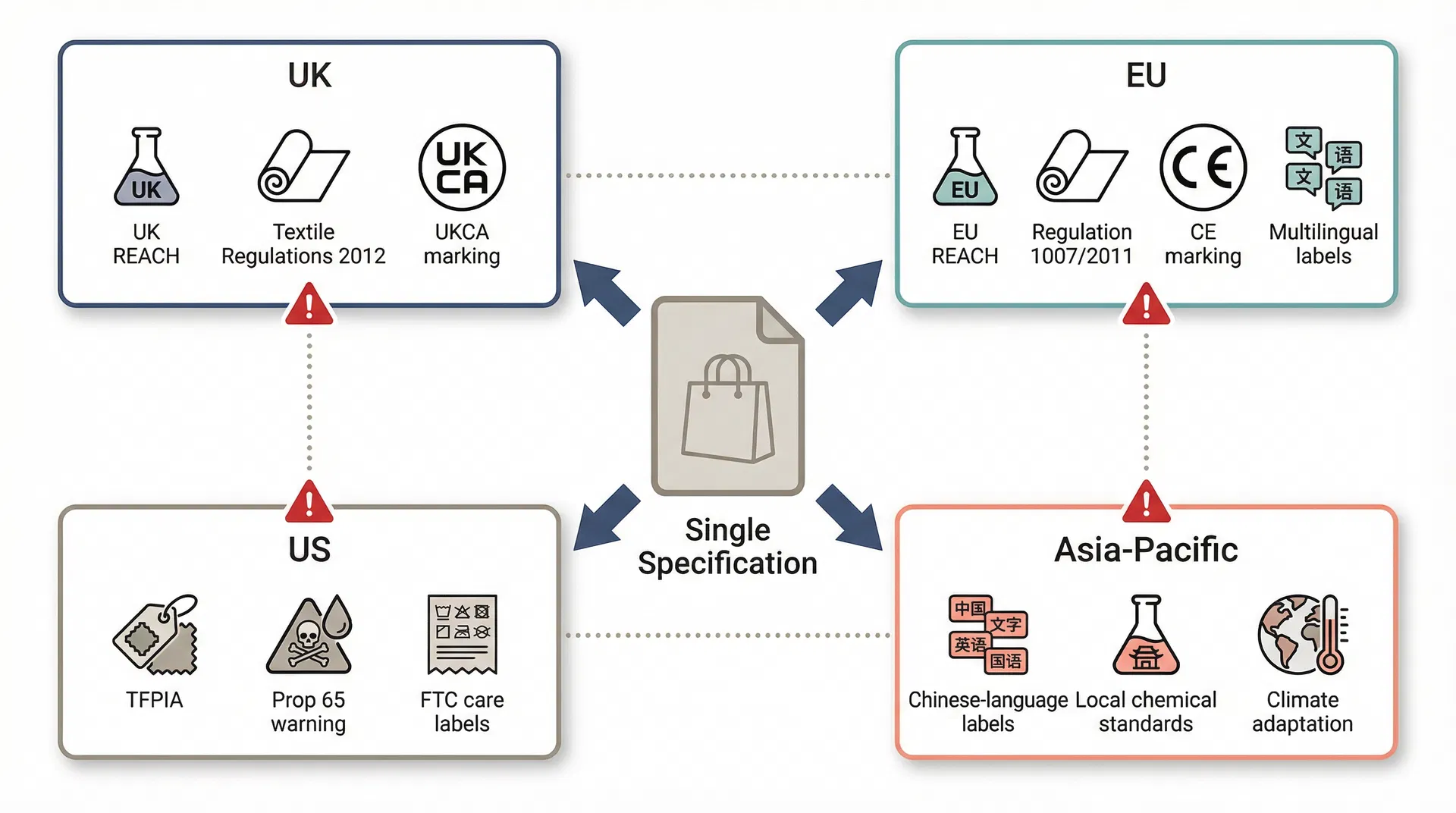
The climate dimension is less regulated but equally consequential for how the gift is perceived. A 280gsm cotton tote bag is a sensible weight for the UK, where temperatures rarely exceed thirty degrees and the bag will primarily be used indoors or in mild outdoor conditions. That same weight becomes oppressive in Singapore, where average humidity exceeds eighty per cent and temperatures sit above thirty degrees year-round. The bag feels heavy, absorbs moisture, and develops a damp quality that undermines the premium positioning the specification was designed to convey. In Dubai, the combination of extreme heat and air-conditioned interiors creates a temperature cycling effect that accelerates material fatigue in natural fibres. A bag that lasts two years of regular use in Manchester may show visible wear after six months in the Gulf. The specification does not account for this because it was written with UK conditions as the implicit baseline, and climate performance is rarely included in corporate gift bag specifications.
Cultural expectations around material choice and sustainability messaging create a subtler but equally significant divergence. In the UK and Northern Europe, organic cotton and unbleached natural finishes carry strong positive associations with environmental responsibility. The slightly rough texture and undyed appearance signal authenticity and ethical sourcing. In parts of Asia and the Middle East, the same aesthetic can be interpreted as unfinished or low-quality. Markets where corporate gifting carries significant relationship-building weight — Japan, South Korea, the Gulf states — tend to associate gift quality with visible refinement: smooth finishes, structured materials, precise construction details. An unbleached cotton tote that communicates "we care about the environment" in London may communicate "we did not invest in a proper gift" in Tokyo. The specification captures material properties but not the cultural semiotics that determine how those properties are interpreted.
The production reality compounds these problems in ways that the specification document cannot anticipate. When a procurement team places a single large order for global distribution, the factory produces one batch to one specification. But if regional label variants are required, the production run must accommodate multiple label configurations — different languages, different compliance marks, different care instruction symbols. This is not a trivial adjustment. Label changes require separate printing setups, separate quality control checks, and separate packaging streams. A factory quoting for a single-specification run will price the order assuming uniform production. When regional variants are introduced mid-production or discovered as a requirement after the bags have been manufactured, the cost and timeline implications can be substantial. Relabelling finished goods is possible but introduces its own quality risks: adhesive labels that peel, sewn-in labels that alter the bag's interior finish, or heat-transfer labels that leave visible marks on the fabric.
The customs and duty classification adds a final layer of complexity that procurement teams rarely factor into the specification process. A cotton tote bag classified under one Harmonised System code in the UK may be classified differently in the destination country depending on its construction, material composition, and intended use. A bag with a zip closure may attract a different duty rate than one with an open top. A bag containing more than a certain percentage of synthetic material in its lining may be reclassified from "cotton bag" to "mixed textile article" in some jurisdictions, changing both the duty rate and the applicable labelling requirements. These classification decisions are made by customs officials in the destination country, not by the exporting company, and they can vary between shipments even when the product is identical.
The practical consequence of all this is not that global corporate gifting programmes are impossible. Companies distribute branded merchandise across dozens of markets successfully. But they do so by treating the specification as a framework that requires regional adaptation, not as a fixed document that can be applied uniformly. The procurement teams that encounter problems are those that treat "one specification, one supplier, one production run" as an efficiency gain without recognising that the efficiency is purchased at the cost of compliance risk, cultural misalignment, and material unsuitability in at least some of their target markets.
Understanding how the [broader process of custom bag production](/blog/custom-bag-customization-process-uk-guide) intersects with multi-market distribution requirements reveals why the specification stage is where regional adaptation must begin — not at the shipping stage, where it is too late to change the product, and not at the labelling stage, where retrofitting compliance creates its own quality and cost problems.
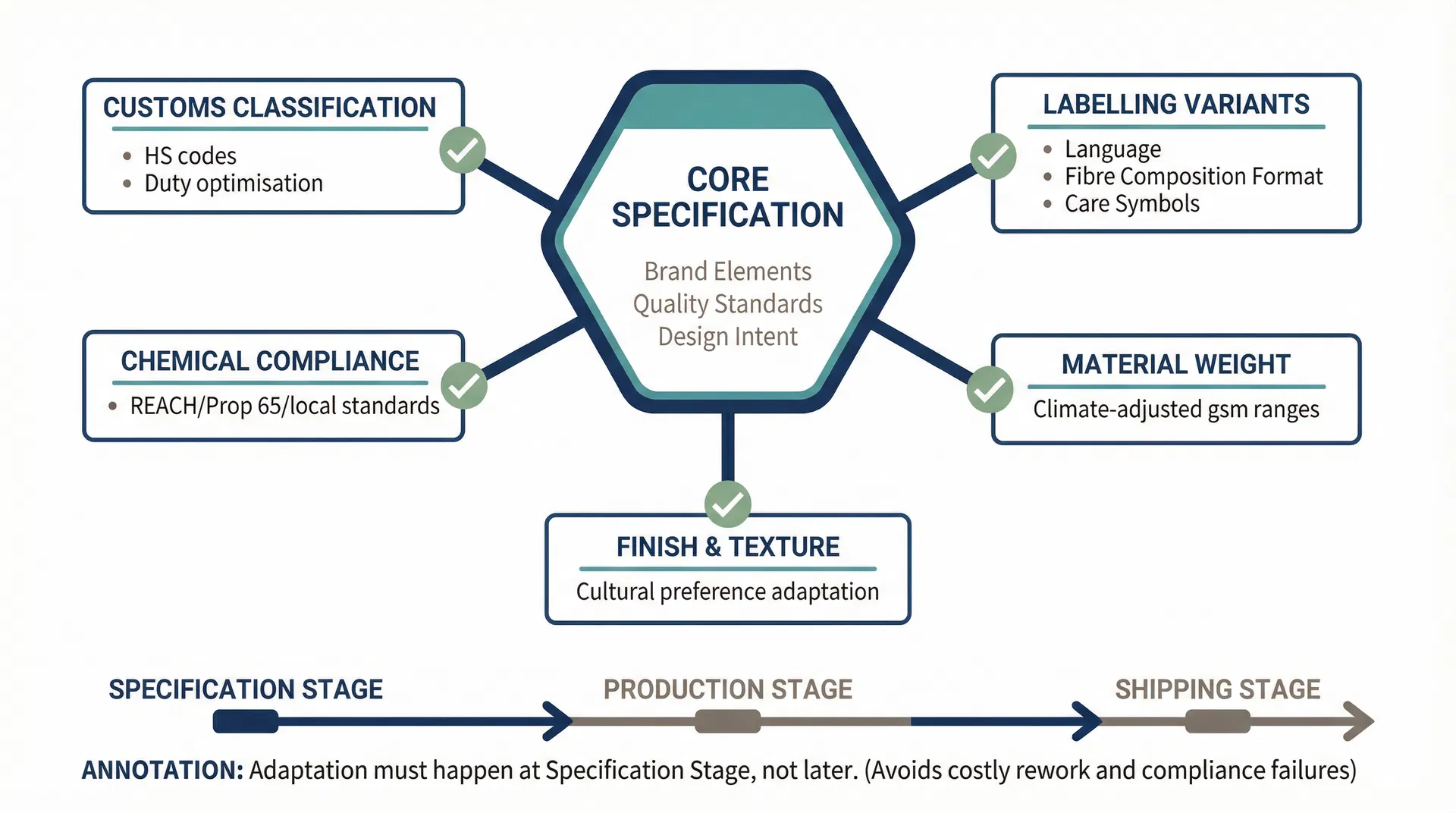
What tends to work in practice is a hub-and-spoke specification model: a core specification that defines the brand elements, quality standards, and design intent, surrounded by regional appendices that address labelling, material weight, finish preferences, and compliance requirements for each target market. This approach preserves brand consistency — the bag is recognisably the same product everywhere — while allowing the technical details to flex according to local requirements. It does require more work at the specification stage, and it may require working with suppliers who can accommodate variant production within a single order. But it prevents the far more expensive scenario of discovering, after ten thousand bags have been produced and shipped, that the specification that works in one market creates a compliance problem, a cultural misstep, or a material failure in another.
The misjudgment is not in wanting consistency across markets. Consistency is a legitimate brand objective. The misjudgment is in assuming that a single technical specification can deliver that consistency when the regulatory, cultural, and environmental contexts in which the bag will be received are fundamentally different. The specification that feels like a shortcut — one document, one production run, one set of approvals — becomes the most expensive path when it produces a bag that is compliant in the home market and problematic everywhere else.